The Slaves' Betrayal
Opening Scene - August 24, 410 CE
The pre-dawn stillness over Rome was shattered by the blaring of Gothic war horns. Near the Salarian Gate, a slave girl named Marcella watched in horror as the massive bronze doors groaned open, not by force, but by treachery. Later accounts would claim that sympathetic slaves had unlocked the gates in the dead of night, allowing Alaric's Gothic warriors to pour into the sleeping city like a torrent of iron and fury.
Inside her master's villa on the Caelian Hill, Marcella could hear the growing chaos: the pounding of thousands of boots on ancient cobblestones and the splintering of wood as doors were smashed. The first screams of citizens awakening to their nightmare followed close behind. Through a high window, she saw the orange glow of fires beginning to illuminate the dark sky over the Forum Romanum.
For the first time in eight centuries, Rome was being sacked by a foreign army. The unthinkable had become reality. Wealthy senators fled their marble palaces while common people sought sanctuary in Christian churches. Alaric's Visigoths moved methodically through the city's fourteen districts. They weren't mindless barbarians but disciplined soldiers with clear orders: seize gold, silver, and silk. Take highborn hostages for ransom. Spare those who sought refuge in churches.
The Rome they now occupied was no longer the Rome of Caesar or Augustus. Its population had dwindled from nearly a million to barely 200,000. The emperor himself resided far away in Ravenna. Yet it remained the symbolic heart of empire, and its fall would send shockwaves across the Mediterranean world.
Historical Context: The Road to Catastrophe
The sack of Rome did not come without warning. For decades, the Western Roman Empire had been struggling with internal decay and mounting external pressure. The crisis began in the late 4th century when Goths, fleeing the advancing Huns, sought refuge inside Roman territory. In 376 CE, Emperor Valens allowed thousands of Goths to cross the Danube River and settle in Roman lands as foederati (allied soldiers).
This massive population movement proved disastrous. Poor treatment by Roman officials led to Gothic revolts, and at the Battle of Adrianople in 378 CE, the Goths annihilated a Roman army and killed Emperor Valens himself. That defeat shattered Rome's aura of invincibility and opened a new era in which Germanic peoples increasingly dictated terms to the empire.
Alaric emerged as leader of the Visigoths around 395 CE. Raised among Romans and trained in their military tactics, he was no mere barbarian chieftain. He was a sophisticated commander who understood both Roman strengths and Roman weaknesses. When the empire reneged on payments and land promises to his people, Alaric launched a series of invasions into Italy.
The Western Empire's defense rested with Stilicho, a brilliant general of half-Vandal descent who served as regent for the young Emperor Honorius. For years, Stilicho maintained an uneasy balance, alternately fighting and negotiating with Alaric. In 408 CE, palace intrigue led to Stilicho's execution. With him died the empire's best hope for managing the Gothic threat.
Main Narrative: Three Days That Changed History
The sack of Rome unfolded across three days that revealed both the worst and best of human nature. From multiple contemporary accounts, we can piece together the drama that played out in different corners of the city.
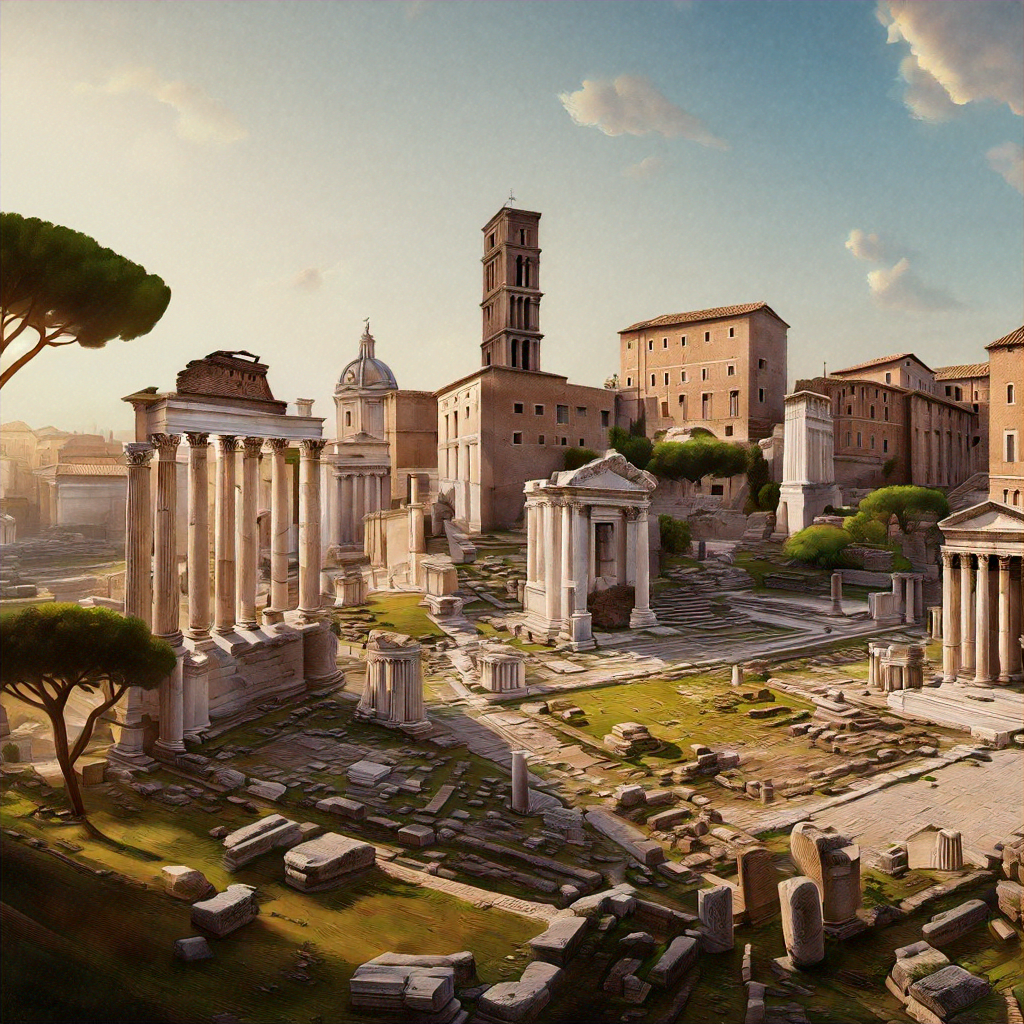
In the Forum Romanum, Senator Quintus Aurelius watched as Goths methodically stripped gold leaf from the roof of the Temple of Saturn. A lifelong pagan, he later wrote: "I saw barbarians handle with respect the sacred vessels they did not understand, even as they desecrated our ancient temples. They were more interested in portable wealth than destruction for its own sake."
Near the Subura district, the wealthy widow Anicia Faltonia sheltered dozens of refugees in her home. When Gothic soldiers arrived, she met them at the door speaking their own language. She had spent years in Constantinople and learned Gothic, and she negotiated safe passage for her household by offering her silver collection. Her account provides a crucial perspective: "They were not monsters but men, some cruel, some kind, all following their leader's commands."
In the Lateran basilica, Bishop Innocent I (who had fortuitously gone to Ravenna before the siege) received regular reports from his clergy. They described how Alaric, despite being Arian Christian, honored his promise to respect Catholic churches as sanctuaries. The basilica of St. Peter, St. Paul Outside the Walls, and other major churches became crowded refuges for Romans of all social classes.
Not all areas were spared. The Caelian and Aventine Hills saw significant destruction, the great food warehouses along the Tiber were looted, and many aristocratic homes were stripped bare. Yet compared to ancient sacks of cities, the violence was relatively controlled. Alaric knew that excessive brutality would undermine his longer-term political goals.
The Visigoths departed after three days, carrying enormous wealth and hundreds of high-value hostages. They had achieved their immediate aims without destroying the city's basic infrastructure or its population. The psychological impact, though, far exceeded the physical damage.
The Aftermath and Legacy
News of Rome's fall sent shockwaves through the empire and beyond. In distant Bethlehem, St. Jerome wrote: "My voice sticks in my throat, and, as I dictate, sobs choke my utterance. The City which had taken the whole world was itself taken."
The sack dealt a devastating blow to Roman prestige and self-confidence. If Rome itself could fall, what place was safe? Pagans blamed the empire's adoption of Christianity for angering the old gods. Christians struggled to explain how God could allow the seat of Christian empire to fall to heretical Arians. Both communities were shaken in ways that went well beyond the physical damage to the city's buildings and storehouses.
St. Augustine of Hippo wrote his masterwork "City of God" partly in response to these questions, arguing that earthly kingdoms must fall while only the heavenly kingdom endures. The sack thus contributed to fundamental shifts in how both classical and Christian civilization viewed history, power, and divine providence.
Looking Ahead
The sack of 410 CE marked the beginning, not the end, of Rome's final decline. In our next episode, we'll explore how Emperor Honorius and his court responded to this catastrophe from their secure refuge in Ravenna, and how their decisions further weakened the empire's ability to prevent future disasters. The Eternal City had fallen once. It would fall again.
Editor's Context
Read this episode as part of a longer argument about institutional strain: Rome did not simply collapse because one battle, emperor, or migration went wrong. The important pattern is how military pressure, political legitimacy, taxation, and local survival choices reinforced each other. The date markers (000, 410 CE) are included because chronology is one of the easiest places for narrative history to become misleading. The episode's themes (history, empire, power) are the editorial lens for weighing cause and consequence rather than treating the story as isolated trivia.
Reviewed under the EmpiresDiary editorial workflow by Obadiah.
Sources & Further Reading
Selected bibliography for this series
The Fall of the Roman Empire: A New History of Rome and the Barbarians
Peter Heather, The Fall of the Roman Empire: A New History of Rome and the Barbarians. Oxford University Press, 2005. (scholarly)
The Fall of Rome and the End of Civilization
Bryan Ward-Perkins, The Fall of Rome and the End of Civilization. Oxford University Press, 2005. (scholarly)
The World of Late Antiquity
Peter Brown, The World of Late Antiquity. Thames & Hudson, 1971. (scholarly)
Res Gestae
Ammianus Marcellinus, Res Gestae. Primary late Roman narrative source for the fourth century. (primary)
Drafted with AI. Edited and fact-checked by Obadiah before publication. See the workflow and editorial policy.