Blood of the Wolf
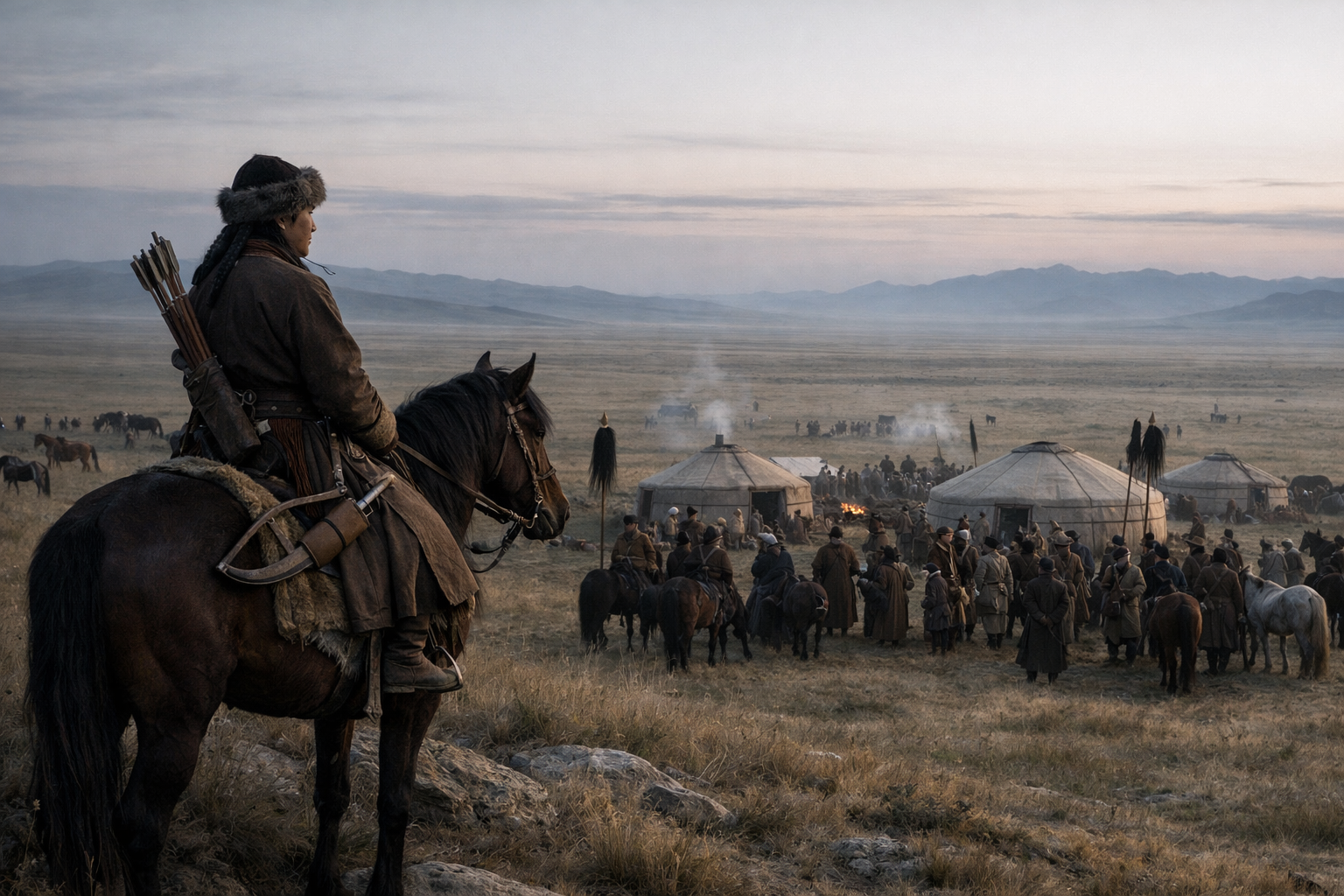
The Frozen Exile
Winter, c. 1180s CE - Northern Mongolia
The bitter wind cut across the frozen steppes as young Temujin pressed close to his mother Hoelun. He was an adolescent and had already watched his father die at the hands of rival Tatars, then seen his clan walk away, convinced a child could lead them nowhere. What remained was a small, precarious household: his mother, his siblings, and a handful of servants scratching out a life on the edges of Mongolian society.
That winter tested them every day. They dug for roots beneath the snow and set traps for marmots and rabbits. Temujin learned to draw a bow with fingers gone numb from cold, shooting birds that meant the difference between hunger and another day alive. His older half-brother Begter made things worse by lording over their meager supplies and keeping the best portions for himself.
One morning, as pale light spread across the frost-covered grasslands, Temujin found that Begter had stolen the small fish he'd caught the day before. What followed would shape the future of Asia. Temujin and his full brother Khasar tracked Begter into the snow and ambushed him with their bows, killing him and ending the threat he posed to the family's fragile unity. Most accounts place Temujin at roughly thirteen or fourteen years old at the time, though the exact date remains uncertain.
Temujin carried that lesson for the rest of his life: division meant death, while loyalty was the only currency that mattered. The cruelty of his early years was shaping the man who would become Genghis Khan, supreme ruler of the largest contiguous land empire in history.
A Fractured Land
12th Century Mongolia
The Mongolia of Temujin's youth was a patchwork of competing tribes and confederations. The main groups, the Merkits, Naimans, Keraits, Tayichiud, and Tatars, each fought for control of pastureland and water sources. Political power rested on a shifting web of alliances, marriages, and blood brotherhoods known as anda.
Society was organized outward from the ger (yurt) as the basic family unit, grouped into clans (oboq) and tribes (ulus). Leadership was generally hereditary, but a chief's authority depended on his ability to feed his followers and win in battle. Confederations were loose and changeable, with loyalty bending toward whoever offered the most immediate advantage.
Trade routes crossing the steppes linked China with Central Asia and points west, yet the Mongols were generally looked down upon by their more "civilized" neighbors. The Jin Dynasty of northern China kept its influence over the Mongol tribes through a deliberate policy of divide-and-rule, playing one group against another to prevent any single power from consolidating.
This was the world that made Temujin. The landscape demanded physical toughness and political cunning in equal measure. From it he drew superb horsemanship, sharp archery skills, and an instinctive grasp of mobile warfare that would eventually overturn the military assumptions of two continents.
Main Narrative: The Path to Power
1185-1206 CE
Temujin's rise began with his marriage to Borte of the Konkirat tribe, a match his father had arranged before his death. The alliance gave him his first base of support outside his own family. It didn't hold for long. Shortly after the wedding, Borte was kidnapped by the Merkits, a rival tribe settling an old grievance against Temujin's father.
His response was his first real political move. He called on Toghrul Khan of the Kerait tribe, his father's blood brother, and on Jamukha, his own childhood anda. The three launched a raid that brought Borte back, and in doing so Temujin showed he could build alliances and lead men under pressure.
The partnership with Jamukha didn't last. As Temujin's following grew, he began pulling apart the old Mongol social order. Other leaders reserved the richest plunder for their noble warriors. Temujin split it evenly with common soldiers. He promoted men on loyalty and ability rather than birth, which won him the loyalty of commoners and earned the hatred of the established aristocracy.
The break with Jamukha had roots stretching back to the Battle of the Thirteen Wings, fought at Dalan Baljut around 1187. That engagement was a defeat for Temujin, who was routed and forced to flee. Yet Jamukha's subsequent cruelty toward captives, including boiling some alive, drove many followers away from him and toward Temujin in the years that followed. The two rivals continued to clash, and by 1201 the conflict had become a direct struggle over Mongolia's future. Jamukha stood for the old order. Temujin offered something different: a unified Mongol people under one leader, bound by merit and shared purpose.
Over the years between 1201 and the final kurultai, Temujin restructured his forces into units of ten, one hundred, and one thousand, cutting across tribal lines and replacing old loyalties with a clean decimal system. Coordination improved. Tribal politics lost their grip on the chain of command.
By 1206 CE, every major rival tribe had been defeated or absorbed. At a great assembly (kurultai) on the banks of the Onon River, Temujin was proclaimed Genghis Khan, Universal Ruler of all Mongolia. The old tribal divisions were dissolved and the people were reforged into a single nation, governed by a new legal code called the Yasa.
Consequences: The Foundation of Empire
The unification of Mongolia under Genghis Khan created the platform for the largest contiguous land empire in history. The changes he made were far-reaching:
- The decimal military organization became the model for armies across Asia and Europe
- The Yasa established consistent laws where tribal custom had once varied wildly
- A new social contract took hold, placing loyalty to the state above tribal affiliation
- Merit-based advancement opened paths that birth alone had previously controlled
- A professional corps of administrators began to take shape, laying the groundwork for empire
Together these shifts turned a collection of warring tribes into a sophisticated military state capable of projecting force across continents.
The World Trembles
Standing before his unified nation in 1206 CE, Genghis Khan was already looking outward. To the south lay the wealthy Jin Dynasty, whose emperors had spent decades manipulating Mongol politics. To the west, the trade cities of Central Asia waited. The next episode follows the Mongol armies into their first campaigns beyond the steppes, and the shockwaves that rolled across Asia for centuries after.
Editor's Context
Read this episode through mobility and information. Mongol power rested not only on battlefield speed, but on logistics, intelligence, delegated rule, and the ability to turn conquest into communication across Eurasia. The date markers (1201 CE, 1171 CE) are included because chronology is one of the easiest places for narrative history to become misleading. The episode's themes (history, empire, power) are the editorial lens for weighing cause and consequence rather than treating the story as isolated trivia.
Reviewed under the EmpiresDiary editorial workflow by Obadiah.
Drafted with AI. Accuracy review and corrections are ongoing — if you spot an error, please report it. See our workflow and editorial policy.