Blood and Thunder on the Steppes
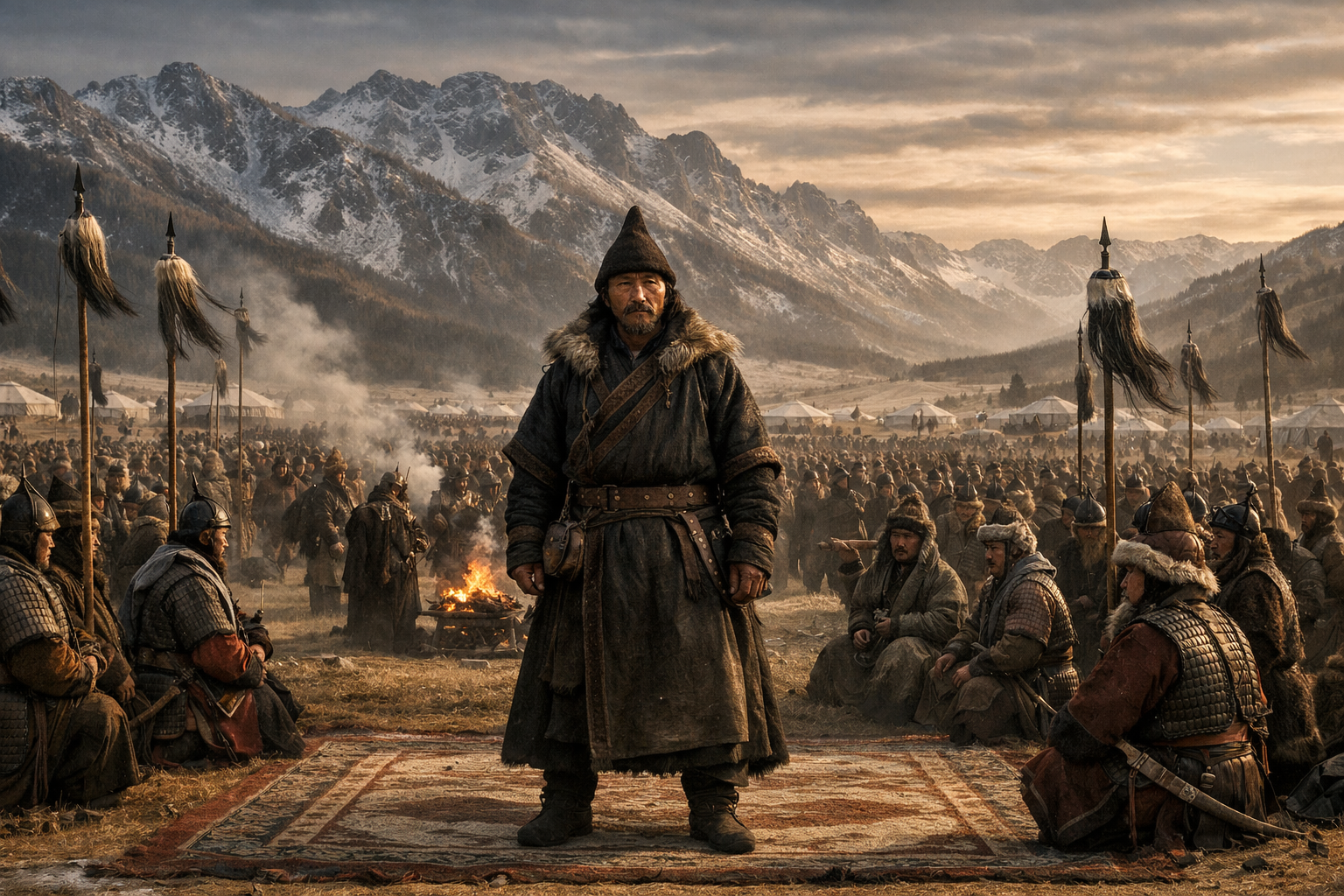
The Kurultai of 1206
The wind howled across the sacred grounds of Mount Burkhan Khaldun as thousands of warriors gathered in the early spring of 1206. Their deel robes and horse-hair banners whipped in the fierce gusts sweeping down from the snow-capped peaks. At the center of this vast assembly stood Temüjin, the man who would soon be proclaimed Genghis Khan, his weathered face bearing the scars of countless battles and betrayals.
Before him stretched representatives from every major tribe of Mongolia: the proud Merkits, the fierce Naimans, the numerous Kereyids, and dozens more who had spent generations locked in blood feuds and raids against one another. Many had been bitter enemies just months or years before. Now they gathered to do what no one thought possible, which was unite under a single banner.
Tension crackled through the assembly as tribal chieftains and noble warriors took their places according to strict protocol. The smell of fermented mare's milk and roasted mutton drifted through the air as servants prepared the ritual feast. Shamans burned juniper branches, the sacred smoke rising to the Eternal Blue Sky as they chanted ancient prayers.
Temüjin's closest advisors stood nearby. His blood brother Jamukha was present, though their friendship had been tested by war. His loyal general Subutai was already showing the tactical brilliance that would help forge an empire. His sons Jochi, Chagatai, Ögedei, and Tolui each watched intently as their father prepared to claim supreme power.
The moment had come at terrible cost. Decades of warfare, betrayal, and strategic alliances had led to this gathering. Temüjin had survived enslavement, the murder of his father, abandonment by his clan, and countless attempts on his life. He had unified the tribes not purely through military might but through a revolutionary system of loyalty and merit that cut across traditional tribal bonds.
A Divided Land
Prior to Temüjin's rise, the Mongolian steppes were a patchwork of competing tribes and confederations. The harsh environment demanded a nomadic lifestyle, with tribes following seasonal migration patterns alongside their herds of horses, sheep, and goats. Alliances were fluid. Raids for livestock and women were common, and blood feuds could last generations.
The major powers in the region included the Jin Dynasty (founded and ruled by the Jurchen of Manchuria) controlling northern China, the Song Dynasty in southern China, and the Tangut Xi Xia kingdom to the west. These settled civilizations generally viewed the steppe peoples as barbaric raiders to be either paid off or contained behind walls and fortifications.
Tribal structure rested on the ulus system, groups bound by family ties and loyalty to a khan or chief. The Borjigin clan, to which Temüjin belonged, claimed descent from the Blue Wolf and had once been powerful but had fallen into decline. When Temüjin's father was poisoned by Tatars and Temüjin was only nine years old, the clan abandoned his mother and young siblings rather than bear the burden of supporting them.
Medieval Mongolia was shaped by both internal conflicts and external pressures. Trade routes crossing the steppes brought wealth but also fierce competition. Chinese dynasties played tribes against each other through bribes and titles, and the Jurchen Jin Dynasty had grown particularly powerful, forcing many Mongol tribes to serve as buffer states or tributaries.
Main Narrative: Forging Unity Through Revolution
Temüjin's rise came through military innovation, political acumen, and social revolution. He built a new meritocracy where loyalty and ability mattered more than birth or clan membership, discarding the traditional tribal system that had kept the steppes fractured for centuries. Talented men were welcomed regardless of their origin, and even former enemies could rise to positions of authority by proving their worth. Loyalty was earned and rewarded rather than assumed through bloodline, a principle that set Temüjin's movement apart from every previous attempt to unite the steppe tribes.
His first major victory came against the Merkits, who had once kidnapped his wife Börte. Using a coalition that included Toghrul Khan of the Kereyids and his blood brother Jamukha, Temüjin crushed the Merkits and rescued Börte. The alliance didn't hold. Jamukha and Temüjin eventually became rivals for leadership of the Mongol tribes.
The revolutionary aspects of Temüjin's system included:
- Creating the decimal military system (units of 10, 100, 1000, and 10000)
- Mixing troops from different tribes to break old loyalties
- Promoting based on merit rather than birth
- Sharing plunder equally among all warriors
- Protecting merchants and diplomatic envoys
- Creating a writing system and code of laws
By 1204 Temüjin had crushed the Naimans and Merkits. The following year his last great rival, Jamukha, was betrayed by his own followers and handed over to Temüjin, who had him executed in 1205 on the eve of the 1206 kurultai. According to the Secret History of the Mongols, Jamukha acknowledged at the end that there could not be two suns in the sky nor two khans on the earth, asked to be put to death without the shedding of blood as befitted a noble warrior, and promised that his spirit would protect Temüjin's descendants eternally and forever.
Consequences: Birth of an Empire
The Kurultai of 1206 marked the birth of the Mongol Empire. Temüjin was proclaimed Genghis Khan, Universal Ruler, and began consolidating power through new institutions and sweeping reforms. He created:
- A professional army with iron discipline
- The Yasa code of laws applying to all
- A system of relay stations for communication
- A royal guard of 10,000 elite warriors
- Administrative divisions transcending tribal boundaries
These innovations transformed a collection of warring tribes into the nucleus of what would become the largest contiguous land empire in history. The unified Mongol nation now had the organization and military strength to project power far beyond the steppes.
As the newly proclaimed Genghis Khan surveyed his unified nation in 1206, his ambitions turned outward. The wealthy Xi Xia kingdom to the southwest would be his first target, followed by the mighty Jin Dynasty controlling northern China. The great conquests that would create history's largest land empire were about to begin. Next episode: "Thunder from the East: The Mongol Invasion of China."
Editor's Context
Read this episode through mobility and information. Mongol power rested not only on battlefield speed, but on logistics, intelligence, delegated rule, and the ability to turn conquest into communication across Eurasia. The date markers (1206, 1000) are included because chronology is one of the easiest places for narrative history to become misleading. The episode's themes (history, empire, power) are the editorial lens for weighing cause and consequence rather than treating the story as isolated trivia.
Reviewed under the EmpiresDiary editorial workflow by Obadiah.
Drafted with AI. Accuracy review and corrections are ongoing — if you spot an error, please report it. See our workflow and editorial policy.