The Great Raid West: Subutai's Cavalry Storm
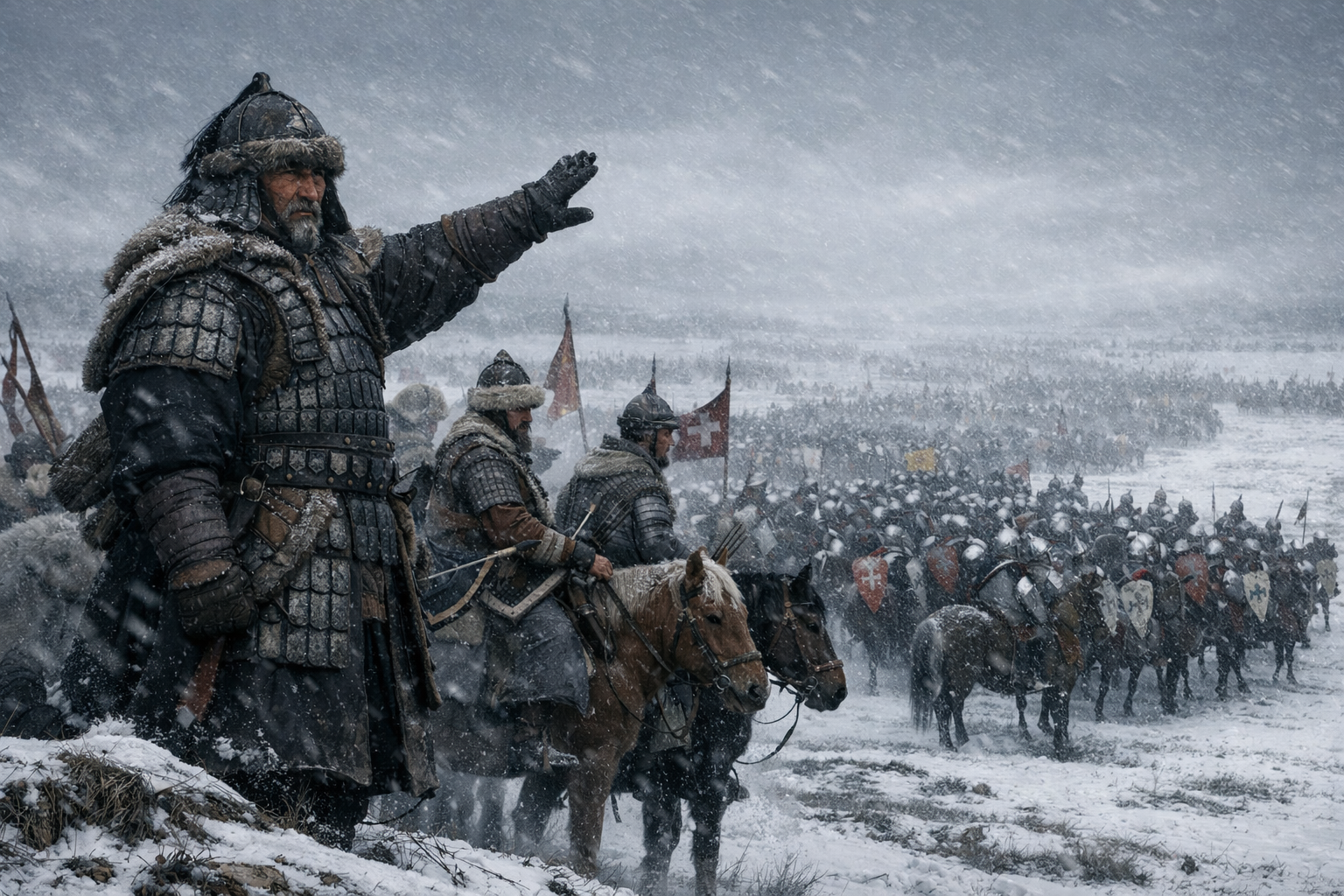
Winter, 1241 CE
The frozen plains of Hungary lay silent under a steel-gray sky. Snow blanketed the rolling grasslands that reminded the Mongol warriors of their homeland steppes. But General Subutai, the tactician who had helped Genghis Khan forge an empire, saw something else in these lands: the perfect killing ground for Europe's heavily armored knights.
From his position on a low hill, the aging commander watched through the swirling snow as Hungarian heavy cavalry assembled in the valley below. Their armor gleamed dully in the winter light, proud banners of Christian kingdoms fluttering in the bitter wind. King Béla IV of Hungary had marshaled his full army to face the Mongol threat, gathering tens of thousands of men, by some accounts up to 100,000, among the largest armies the kingdom had ever fielded.
Subutai allowed himself a thin smile. After two years of lightning raids and strategic retreats across Eastern Europe, he had finally drawn his prey into position. The European knights, with their rigid tactics and cumbersome armor, had no idea they were riding into one of the most sophisticated military traps ever devised.
Behind him waited 20,000 Mongol horse archers, light, mobile, and lethal. They had trained since childhood to shoot accurately at full gallop, using powerful composite bows to deadly effect. More to the point, they operated as a disciplined army rather than a mob of individual warriors seeking personal glory, which was more than could be said for the force assembling below.
Subutai raised his hand, and runners carried his orders to the tumens (units of 10,000) positioned in the hills around the valley. The trap was set. Soon, the pride of European chivalry would learn why the Mongols had conquered more territory in 25 years than Rome had in 400.
The Mongol Western Campaign
The Mongol invasion of Europe grew from a broader strategic vision conceived by Ögedei Khan, son and successor of Genghis Khan. By 1235, Mongol forces had already conquered much of Asia from Korea to Persia. The wealthy kingdoms of Europe represented both a threat and an opportunity.
Command of the campaign went to Batu Khan, grandson of Genghis, but the true military mind behind the operation was Subutai. Born a blacksmith's son, he had risen through merit to become the greatest of all Mongol generals. He had conquered 32 nations and won 65 pitched battles, pioneering tactics that combined speed, deception, and coordinated strikes across vast distances.
The invasion force of approximately 130,000 men was divided into several armies that could operate independently or together. Their first targets were the Russian principalities, which fell one by one between 1237 and 1240. Kiev, the greatest city in Eastern Europe, was captured and sacked in December 1240.
After Kiev, the Mongols split their forces for a two-pronged push into Central Europe. The northern army under Batu Khan and Subutai struck through Poland while the southern army invaded Hungary. Their advance was aided by detailed intelligence gathered by spies and scouts over the previous decade, and by the political fragmentation of medieval Europe, which made any coordinated Christian response nearly impossible.
Main Narrative - The Battle of Mohi
Dawn broke on April 11, 1241, with the Hungarian army under King Béla IV positioned behind the Sajó River. They believed they were safe from immediate attack. During the night, however, Subutai had already sent a detachment downstream to construct a pontoon bridge.
The battle opened with a feigned frontal assault on the main bridge, pulling Hungarian forces into position. While they engaged what they took to be the primary Mongol army, Subutai's main force crossed the river behind them. The Hungarians found themselves caught between two bodies of troops, yet they held their defensive position.
Then came the decisive moment. The Mongols deployed Chinese siege engines to launch flaming projectiles and naphtha bombs into the Hungarian camp. Tents caught fire, horses bolted, and the tight defensive formation began to collapse.
As the Hungarian army broke and began to flee, Batu was eager to charge immediately. Subutai held the line, reasoning that a trapped enemy fights to the death while a fleeing one presents its back to the archers, so the Mongols deliberately left an apparent gap in their encirclement. Hidden Mongol units emerged from the hills on both sides, pouring arrows into the packed mass of men and horses funneled into that corridor. The slaughter was terrible. King Béla barely escaped with his life, and the cream of Hungarian nobility was virtually wiped out. Across Eastern Europe, the story was the same: every force sent against the Mongols was destroyed.
Consequences and Impact
Hungary lost up to half its population in the wake of the invasion, and its fields and villages were left in ruins. The destruction of Kiev permanently shifted the balance of power in Eastern Europe, contributing to the rise of Muscovy (later Russia) as the dominant regional force.
The campaign exposed the gap between Mongol military organization and European feudal armies. Several kingdoms responded with real reforms: a greater reliance on professional soldiers and the development of more sophisticated battlefield tactics. The old model of armored knights charging in formation had been tested and found wanting.
The invasion also connected Europe to the wider Eurasian world in ways that outlasted the fighting. Despite their fearsome reputation, the Mongols established reliable trade routes and postal systems across their territory. European merchants and diplomats soon traveled these routes all the way to China, setting off significant exchanges of culture and technology that would shape both civilizations.
When news of Ögedei Khan's death reached the Mongol armies in Europe, they withdrew to participate in the selection of a new Great Khan. That withdrawal was not the end of Mongol influence in the region. In the next episode, we'll examine how the Golden Horde, established by Batu Khan, dominated Russia and Eastern Europe for centuries, forever reshaping the region's cultural and political landscape.
Editor's Context
Read this episode through mobility and information. Mongol power rested not only on battlefield speed, but on logistics, intelligence, delegated rule, and the ability to turn conquest into communication across Eurasia. The date markers (1241 CE, 000) are included because chronology is one of the easiest places for narrative history to become misleading. The episode's themes (history, empire, power) are the editorial lens for weighing cause and consequence rather than treating the story as isolated trivia.
Reviewed under the EmpiresDiary editorial workflow by Obadiah.
Drafted with AI. Accuracy review and corrections are ongoing — if you spot an error, please report it. See our workflow and editorial policy.