The Wolf and the Dragon
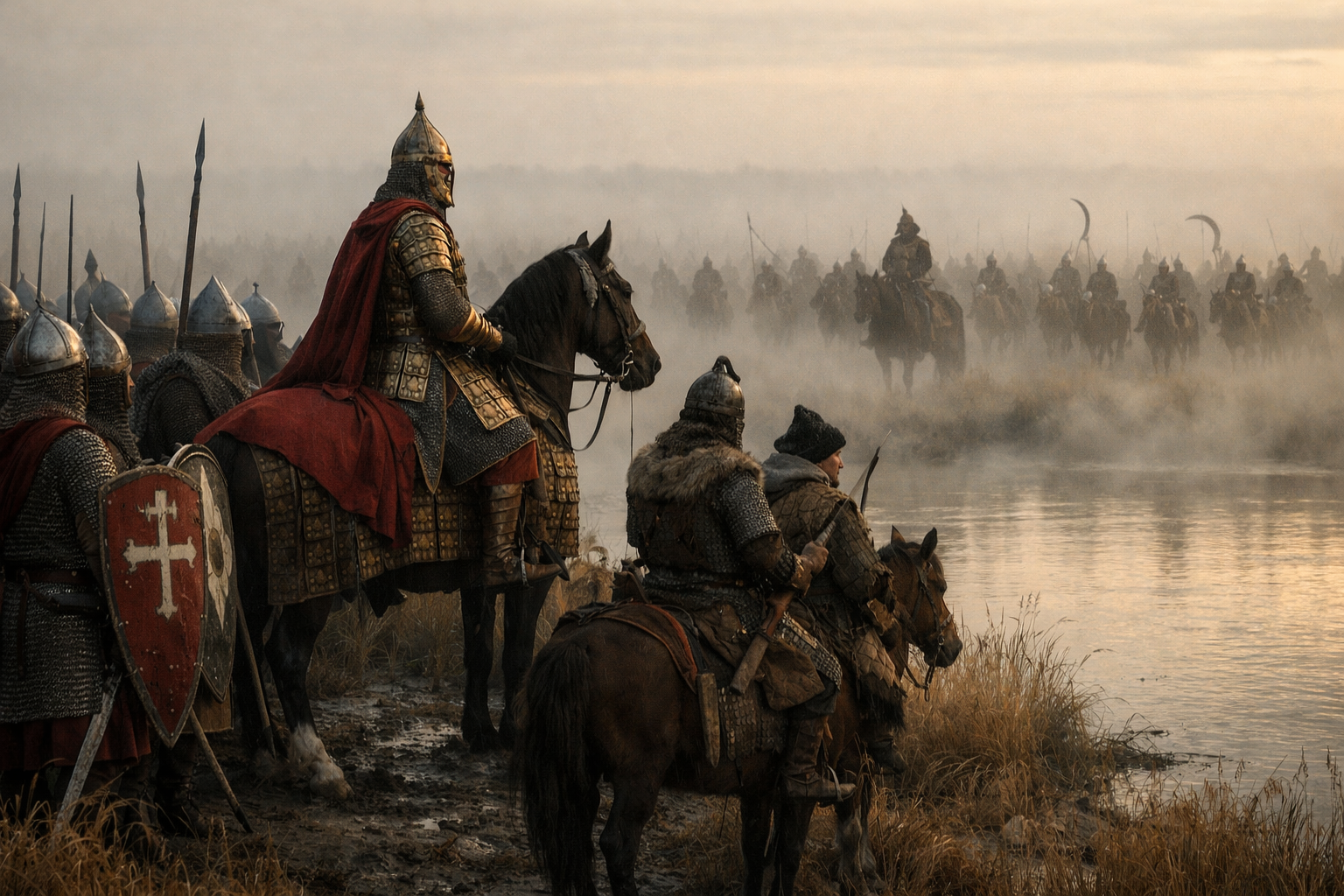
The Banks of the Kalka River, 1223 CE
Morning mist hung heavy over the Kalka River, obscuring the grasslands stretching toward the horizon. On one bank stood the combined armies of the Rus principalities and their Cuman allies, tens of thousands of warriors led by multiple princes, their chainmail catching what little light filtered through the haze. These were the defenders of Christian Europe, confident in their heavy cavalry and the traditional tactics that had served them for generations.
Across the rolling steppes, barely visible through the fog, waited something entirely different: the Mongol tumens under generals Subutai and Jebe. Their lighter-armored horsemen seemed to drift in and out of the mist like ghosts, composite bows at the ready. The Rus princes watched with a mixture of contempt and unease. These were the mysterious warriors who had appeared from the east, chasing the fleeing Cumans across the steppes.
Prince Mstislav the Bold of Halych, resplendent in ornate armor, was by all accounts brimming with confidence and eager to engage. Some of his officers, though, remembered troubling reports of how these nomad warriors had already destroyed powerful kingdoms further east. The Mongol hunting horns echoed across the plain, their eerie notes sending a chill through even the bravest men present.
What the Rus forces could not know was that they were facing one of the most formidable military commanders in recorded history. Subutai, called "the Valiant," had already conquered more territory than any general before him. Born a blacksmith's son on the Mongol steppes, he had risen to become Genghis Khan's most trusted strategist. Now, at 47, he was about to show why the Mongols were rewriting the rules of warfare.
The Evolution of Mongol Military Strategy
The campaign that brought Subutai to the Kalka River was part of a larger reconnaissance mission ordered by Genghis Khan. Following the conquest of the Khwarazmian Empire in 1220, Subutai and Jebe were commanded to lead 20,000 warriors in a sweeping arc through Western Asia and Eastern Europe. This "Great Raid" was designed to test the military capabilities of the regions ahead and gather intelligence for future campaigns.
The Mongol military system that Subutai helped perfect was unlike anything Europe or the Middle East had faced. Where feudal armies relied on heavy cavalry and fixed hierarchies, the Mongols ran a professional force organized decimally: units of 10, 100, 1,000, and 10,000 (tumen). Their tactics fused ancient steppe traditions with hard-won innovations in communication, logistics, and psychological warfare.
Mobility was the foundation of everything. Each Mongol warrior maintained three to five horses, ensuring fresh mounts throughout a battle and the ability to cover ground at speeds that sedentary armies simply could not match. Their composite bows could pierce armor at 200 yards, and a sophisticated system of flags, smoke signals, and messenger riders kept commanders informed across a chaotic battlefield.
The Mongols had already torn through China and Central Asia. Heavy infantry, traditional cavalry formations, fortified cities: none of it had stopped them. Now those same tactical innovations were about to collide with European military traditions that had evolved in near-total isolation from the steppes.
Main Narrative - The Battle and Its Aftermath
The Battle of Kalka River unfolded in three phases. In the first, Subutai's light cavalry hit the Rus forces with relentless hit-and-run attacks, making it impossible to form solid battle lines. The Cumans, who had already experienced these tactics, broke first. They fled back through the Rus ranks and shattered whatever cohesion remained.
Prince Mstislav the Bold, ignoring the counsel of the more experienced Prince Mstislav of Kiev, ordered an aggressive pursuit of what looked like a Mongol retreat. It was exactly what Subutai wanted. The Mongols executed their famous false retreat, drawing the Rus cavalry deeper into the steppes and cutting them off from their infantry support.
The Novgorod First Chronicle records that the Russian regiments fell into confusion and the battle was disastrous, and that there had never been such terror since the beginning of the Russian land. After several days of this running battle, the exhausted Rus cavalry found themselves encircled on ground Subutai had chosen carefully. The Mongol army wheeled and attacked from all directions, horse archers tearing apart the isolated Rus formations.
The final phase was a slaughter. Of the estimated 80,000 Rus warriors who began the battle, roughly 15,000 survived. Prince Mstislav of Kiev and several other captured leaders were executed in a particularly grim fashion: laid under wooden platforms on which the Mongols feasted, the defeated men slowly suffocating beneath the weight. Later European chroniclers would describe the Mongols in demonic terms, a reaction that reflected the profound shock these campaigns produced across the continent.
The battle exposed deep structural problems in European military organization. Divided command, rivalry between princes, and the sheer inflexibility of heavily armored knights proved fatal against an enemy that refused to stand still and fight on conventional terms.
Consequences and Lasting Impact
The defeat at Kalka River forced changes in how the Rus principalities thought about war. Several began placing greater emphasis on mobility and archery. More critically, the battle was a warning of what was coming. When the Mongols returned under Batu Khan in 1237, many of those lessons had already been forgotten, and the disasters that followed were even worse.
The battle also confirmed the value of Mongol intelligence work. Subutai's campaigns produced detailed knowledge of European terrain, fortifications, and military habits, information that proved essential during the later invasion. The Mongols' use of psychological warfare, spreading terror through calculated brutality while offering generous terms to those who surrendered early, became a template repeated across subsequent campaigns.
Military historians now place Kalka River among the pivotal engagements in the history of warfare, a moment when nomadic and sedentary military traditions met head-on. The tactical methods Subutai demonstrated there shaped military thinking for centuries.
As Subutai withdrew eastward after the victory, he left behind a changed world. The next episode will examine how the intelligence gathered during this campaign shaped the massive Mongol invasion of Europe that began in 1237. We will look at how Batu Khan and Subutai applied these lessons to build the largest land empire in history, and how European societies were forced to transform in response to the Mongol threat.
Editor's Context
Read this episode through mobility and information. Mongol power rested not only on battlefield speed, but on logistics, intelligence, delegated rule, and the ability to turn conquest into communication across Eurasia. The date markers (000, 1223 CE) are included because chronology is one of the easiest places for narrative history to become misleading. The episode's themes (history, empire, power) are the editorial lens for weighing cause and consequence rather than treating the story as isolated trivia.
Reviewed under the EmpiresDiary editorial workflow by Obadiah.
Drafted with AI. Accuracy review and corrections are ongoing — if you spot an error, please report it. See our workflow and editorial policy.