The Siege of Zhongdu: Breaking the Jin Dynasty's Iron Gate
A Wall Is Only as Strong as the Men Behind It
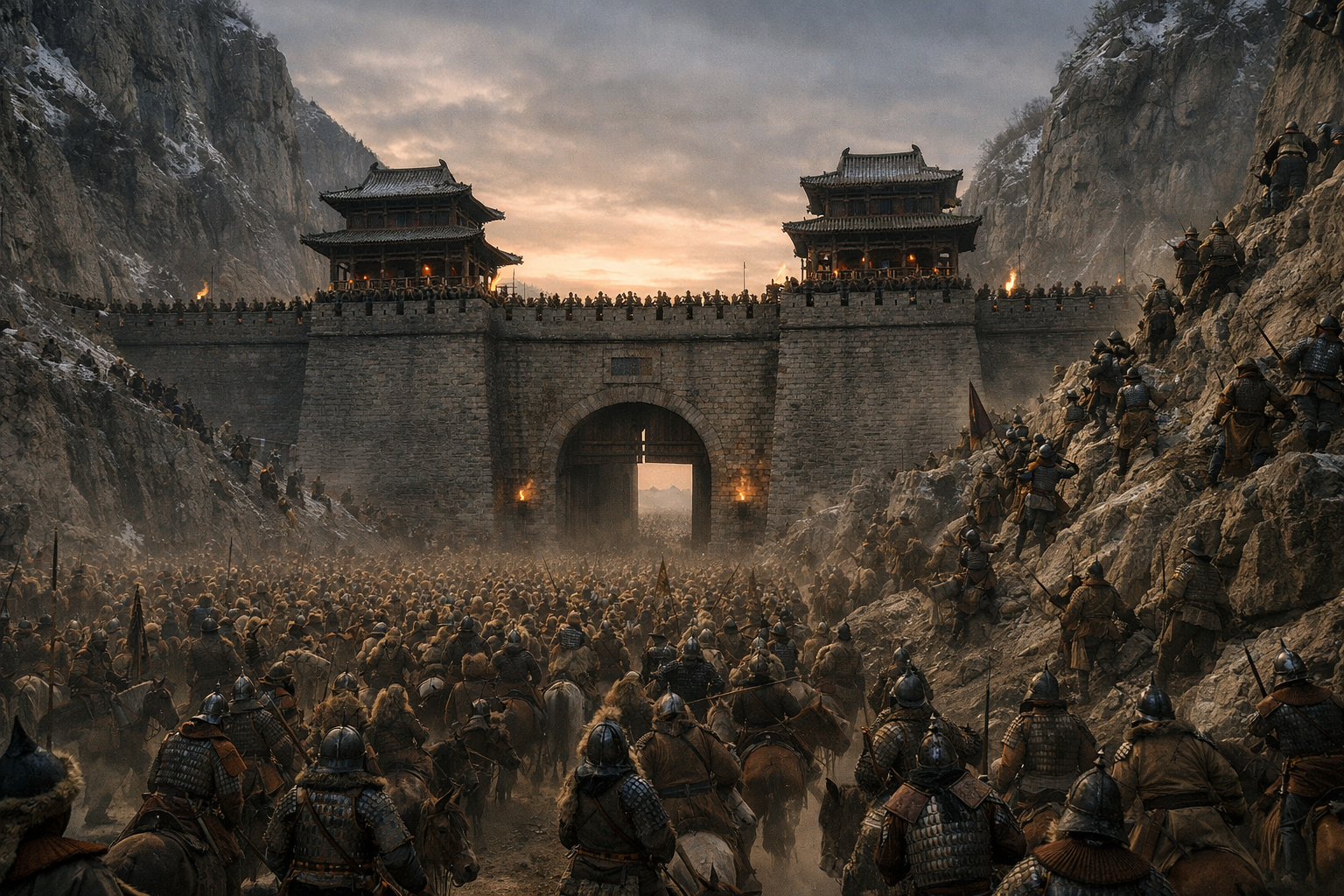
In the spring of 1211 CE, a Mongol army of somewhere between 65,000 and 100,000 riders crossed the Gobi Desert and moved toward the passes of the Yin Mountains. Ahead of them lay the Juyong Pass, one of the principal gateways through the defensive walls the Jin Dynasty had maintained, expanded, and trusted for generations. The Jin emperor Wanyan Yongji, seated in the vast capital of Zhongdu (present-day Beijing), had reason to feel secure. His empire controlled roughly 50 million people, maintained a professional army equipped with gunpowder weapons, and sat behind layers of fortification that had repelled steppe incursions for decades.
Genghis Khan had other ideas.
The Mongol leader had been preparing this campaign with characteristic patience. His grievances against the Jin were real and accumulated: the Jin had historically manipulated Mongol tribal rivalries, executed Mongol envoys, and extracted tribute from steppe peoples for generations. But the invasion of 1211 was not mere revenge. It was the opening move in a systematic effort to extract wealth, manpower, and technical knowledge from the sedentary world. The Great Khan understood, perhaps better than any conqueror before him, that the steppe alone could not sustain an empire.
The Juyong Pass and the First Shock
The Jin commanders at the Juyong Pass were not incompetent. They had fortified the narrow defile with towers and walls, and the garrison was confident in the terrain's natural advantages. What they had not fully anticipated was Mongol operational flexibility. According to sources compiled in the Yuanshi (the official Yuan Dynasty history) and corroborated by the Persian historian Juvaini, Genghis Khan used a classic feigned retreat to draw the Jin cavalry out of their prepared positions. The tactic was so deeply embedded in Mongol military culture that it functioned almost as instinct. Once exposed on open ground, the Jin horsemen were enveloped and destroyed.
The pass fell. The psychological shock radiated immediately. Jin commanders along the northern frontier began abandoning their positions to avoid encirclement, a cascading collapse that Mongol flying columns ruthlessly exploited. By late 1211, raiding parties had penetrated deep into Hebei province, destroying towns, stripping agricultural surplus, and driving hundreds of thousands of refugees toward Zhongdu.
Why Zhongdu Did Not Fall Immediately
Here the Mongols encountered their first serious limitation. Zhongdu was not a pass or a field army. It was a metropolis: a walled city of enormous circumference, defended by a garrison estimated at tens of thousands, supplied with water from the Gaoliang River, and stocked with years of provisions. The Mongols of 1211 had no meaningful siege train. They could devastate the countryside, but they could not reduce a great city by direct assault.
Genghis Khan adapted. He withdrew in 1212 and again in 1213, each time extracting tribute, prisoners, and knowledge. Chinese and Jurchen engineers who understood siege machinery began appearing in Mongol service, whether through capture, defection, or negotiated surrender. The Mongols were industrious students of military technology. They observed, recruited, and incorporated.
The Jin Dynasty, meanwhile, was consuming itself. Emperor Wanyan Yongji was overthrown and killed in a palace coup in 1213, replaced by Xuanzong. The new emperor inherited a state already hemorrhaging territory and military morale. Whole Jin generals defected to the Mongols, bringing their troops with them. One such defector, a Khitan commander named Yelü Liuge, delivered entire northeastern districts into Mongol hands. The betrayal reflected how shallow Jin legitimacy had become among its non-Jurchen subjects.
The Siege of 1214-1215: Starvation as Strategy
By 1214, Genghis Khan had returned with a force now augmented by siege engineers, Chinese catapult crews, and the operational experience of three years of northern Chinese campaigning. He did not attempt to storm Zhongdu's walls directly. He encircled the city, severed its supply lines, and waited.
Emperor Xuanzong made a fateful decision in the spring of 1214. He negotiated a peace, paying an enormous indemnity of gold, silver, silk, and horses, including (according to the Yuanshi) five hundred boys and girls and three thousand horses. Then, crucially, he moved the Jin capital south to Kaifeng. Genghis Khan interpreted this as a breach of faith, a sign that the Jin intended to continue resistance from a more defensible position, and he resumed the campaign.
The final siege of Zhongdu was prosecuted by the Mongol commander Samuqa, together with defected Khitan generals including Shimo Ming'an and Yelü Ahai, with relentless efficiency. The city's garrison, cut off and starving, faced an impossible situation. Contemporary Chinese sources describe conditions inside the walls as catastrophic by early 1215: famine, disease, and the collapse of civil order. A Jin general named Wanyan Fuxing, left in command of the defense, took his own life rather than surrender, a gesture of loyalty to a dynasty already functionally broken.
In the early summer of 1215, Zhongdu fell.
The Burning and What It Meant
The sack lasted for weeks. The destruction was recorded by a Khwarazmian envoy named Baha ad-Din, whose account was preserved by the Persian chronicler Minhaj al-Siraj Juzjani in his Tabaqat-i-Nasiri. Visiting the site roughly a year after the fall, Baha ad-Din described a landscape of bleached bones spread across the plain outside the walls and soil rendered greasy from the remains of the dead. These accounts may carry rhetorical exaggeration in the tradition of Persian historiography, but archaeological evidence confirms massive destruction layers consistent with the city's burning.
The material plunder was staggering. Silk, gold, iron, and grain stores were transported north, along with craftspeople. More consequentially, the administrative records and bureaucratic personnel of Jin governance were either destroyed or absorbed. A Khitan scholar-official named Yelü Chucai had been present inside Zhongdu during the siege. He survived the city's fall and, after a period of Buddhist retreat, was taken into Mongol service in 1218. He would spend the following decades arguing, with considerable success, that the Mongols needed to preserve the administrative machinery of conquered states rather than simply obliterate it. His influence helped shape the later Yuan Dynasty's governance philosophy.
The Military Revolution on the Steppe
The campaign against the Jin between 1211 and 1215 marks a genuine inflection point in Mongol military history. The Mongols arrived as superb light cavalry capable of operational maneuver on a continental scale. They left as a combined-arms force capable of siege warfare, river crossings under fire, and the coordination of infantry, engineers, and cavalry across a complex multi-front theater.
Historian Timothy May, in The Mongol Art of War, argues that the Jin campaigns were the laboratory in which the Mongols developed the siege capabilities they would later deploy from Samarkand to Baghdad to Krakow. The recruitment of Chinese engineers, particularly specialists in fire weapons, counterweight trebuchets, and naphtha-based incendiaries, gave the Mongol army a technological dimension it had previously lacked entirely.
This matters because it reframes the Mongol conquests. They were not the triumph of primitive violence over civilization. They were the triumph of extraordinary organizational intelligence: the ability to identify capability gaps, recruit specialists, and integrate foreign expertise into a command structure that remained distinctively Mongol in its values of speed, deception, and ruthless exploitation of enemy weakness.
The Jin Dynasty's Long Agony
Zhongdu's fall did not end the Jin Dynasty. The court at Kaifeng continued to resist for another two decades. In 1217, Genghis Khan appointed Muqali as viceroy and supreme commander of northern China, tasking him with prosecuting the ongoing campaign against the Jin while the Great Khan turned his attention elsewhere. When Genghis Khan departed for the Khwarazmian Empire in 1219, Muqali continued grinding down Jin resistance in the north. Muqali himself died in 1223 still fighting in northern China, never quite finishing the conquest his master had begun. The final destruction of the Jin came only in 1234, when a combined Mongol-Song Dynasty force stormed Caizhou, the Jin's last refuge. The Southern Song had allied opportunistically with their old northern enemies' destroyers. The last Jin emperor, Wanyan Shouxu, reportedly set fire to his own palace and died in the flames.
The arc from Juyong Pass in 1211 to Caizhou in 1234 spans twenty-three years and represents one of the most sustained military campaigns in medieval history. That it succeeded at all reflects the institutional continuity of the Mongol military system: the ability to maintain strategic direction across the deaths of commanders, the distractions of simultaneous campaigns in Central Asia and Persia, and the logistical nightmare of supplying armies across thousands of kilometers of contested territory.
What the Ruins Remembered
Zhongdu was rebuilt. Under Kublai Khan in the 1260s, it became Dadu, the Great Capital, and eventually the nucleus of what we now call Beijing. The bones and ash of 1215 lie beneath one of the world's great cities. The administrative traditions that Yelü Chucai helped preserve, blended with Mongol governance and later Ming modifications, contributed to the bureaucratic DNA of Chinese statecraft for centuries.
The siege of Zhongdu was not merely a military event. It was the moment the Mongol Empire announced that no wall, however ancient or high or trusted, was the final answer to the question of survival. The answer, it turned out, required something walls could not provide: the willingness to change.
Editor's Context
Read this episode through mobility and information. Mongol power rested not only on battlefield speed, but on logistics, intelligence, delegated rule, and the ability to turn conquest into communication across Eurasia. The date markers (1211 CE — Mongol invasion of Jin Dynasty begins; Juyong Pass breached, 1213 CE — Jin Emperor Wanyan Yongji overthrown and killed in palace coup) are included because chronology is one of the easiest places for narrative history to become misleading. The episode's themes (Military adaptation and technological transfer, The limits of fixed fortification against mobile warfare, Administrative absorption versus destruction of conquered institutions) are the editorial lens for weighing cause and consequence rather than treating the story as isolated trivia.
Reviewed under the EmpiresDiary editorial workflow by Obadiah.
Sources & Further Reading
Episode source notes
Claim: Genghis Khan used a feigned retreat at Juyong Pass to draw Jin cavalry out of prepared defensive positions
Source: Ata-Malik Juvaini, Tarikh-i-Jahangushay (History of the World Conqueror), trans. J.A. Boyle, 1958 (primary)
Claim: The Jin indemnity of 1214 included five hundred boys and girls and three thousand horses according to official records
Source: Yuanshi (Official History of the Yuan Dynasty), compiled 1370, juan 1–2 (primary)
Claim: The Jin campaigns were the laboratory in which the Mongols developed siege capabilities later deployed from Samarkand to Baghdad
Source: Timothy May, The Mongol Art of War, Pen and Sword, 2007 (scholarly)
Claim: A Persian traveler visiting the site of Zhongdu shortly after its fall described bones bleached white and soil rendered greasy from human fat
Source: Ata-Malik Juvaini, Tarikh-i-Jahangushay, trans. J.A. Boyle, 1958, Book I (primary)
Claim: Yelü Chucai argued that the Mongols needed to preserve the administrative machinery of conquered states and influenced later Yuan governance
Source: Igor de Rachewiltz, 'Yeh-lü Ch'u-ts'ai (1189–1243): Buddhist Idealist and Confucian Statesman,' in Confucian Personalities, ed. Wright and Twitchett, Stanford University Press, 1962 (scholarly)
Claim: Muqali died in 1223 still prosecuting the northern China campaign
Source: Paul Ratchnevsky, Genghis Khan: His Life and Legacy, trans. T.N. Jackson, Blackwell, 1991 (scholarly)
Claim: The last Jin emperor Wanyan Shouxu reportedly set fire to his own palace and died in the flames at Caizhou in 1234
Source: Yuanshi, juan 2; also corroborated in Jinshi (History of the Jin Dynasty), juan 18 (primary)
Claim: The Mongol army's recruitment of Chinese engineers, particularly specialists in fire weapons and counterweight trebuchets, gave it siege capabilities it previously lacked
Source: Timothy May, The Mongol Art of War, Pen and Sword, 2007, Chapter 4 (scholarly)
Full bibliography for this series: The Mongol Empire: From Steppes to Superstates.
Drafted with AI. Accuracy review and corrections are ongoing — if you spot an error, please report it. See our workflow and editorial policy.