The Sack of Baghdad: The Night the Abbasid World Ended
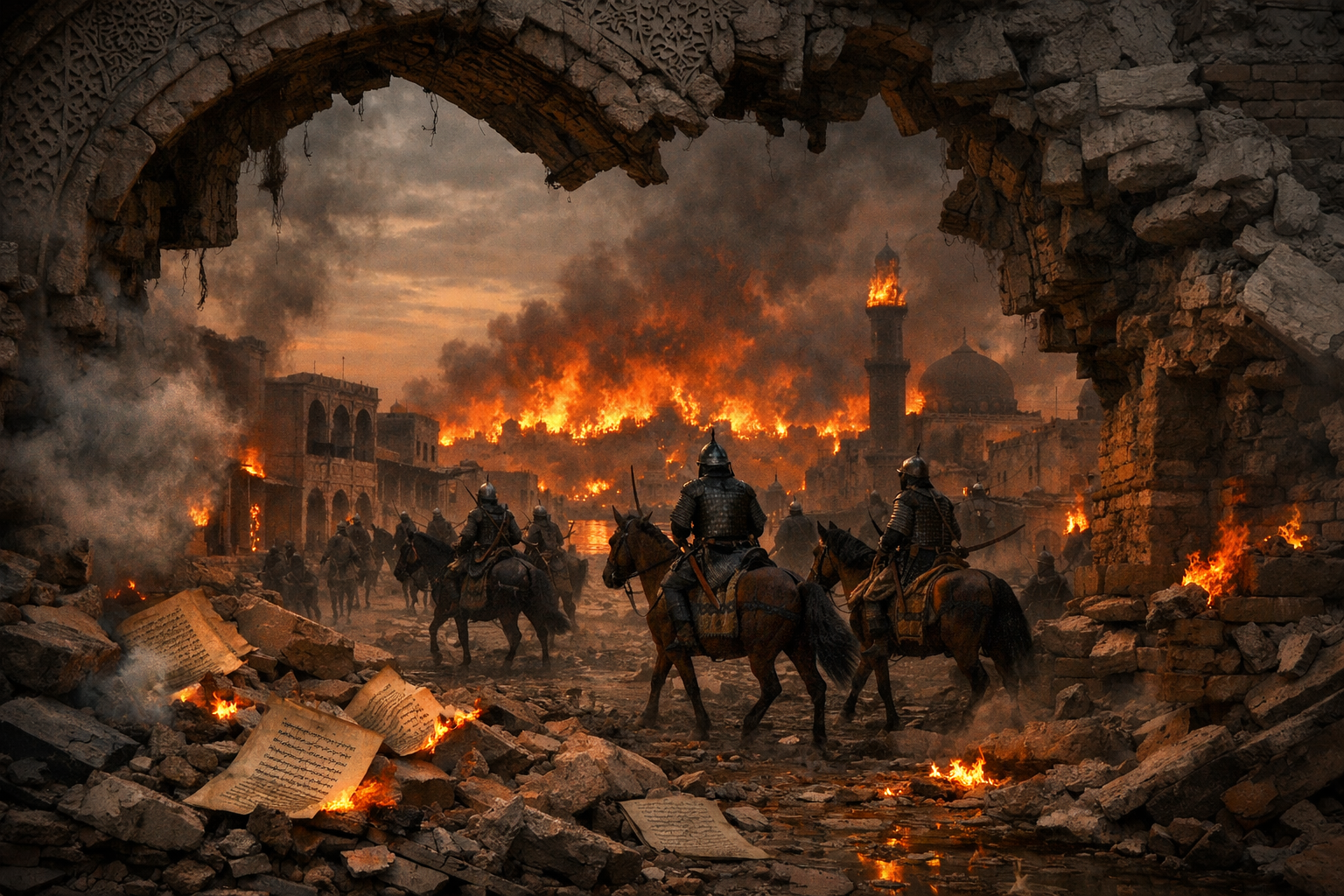
The City at the Center of the World
In the winter of 1257, Baghdad was still, by any measure, a city of extraordinary consequence. Founded in 762 CE by the Abbasid Caliph Al-Mansur on the western bank of the Tigris, it had survived plague, civil war, and the slow erosion of caliphal power to remain the symbolic heart of Sunni Islam. The reigning caliph, Al-Musta'sim Billah, the thirty-seventh of his line, commanded religious authority that stretched from Andalusia to Central Asia, even if his political grip had long since contracted to little more than the city itself and its surrounding territories.
The Mongols had been watching Baghdad for decades. Genghis Khan's successors understood that so long as the Abbasid Caliph could issue fatwas, rally resistance, and provide legitimacy to rival powers, the western flank of the empire remained ideologically exposed. When the Great Khan Möngke formally tasked his brother Hülegü with subduing the Islamic heartland in 1253, the destruction of the caliphate was not an afterthought. It was the campaign's central objective.
Hülegü's Advance: A Coalition of Conquest
Hülegü Khan's army, which began its westward march from Karakorum in 1253 and crossed the Amu Darya into Persia by 1256, was not a simple horde. It was a sophisticated combined-arms force that included Mongol cavalry and Chinese siege engineers, with Georgian and Armenian Christian auxiliaries alongside Persian administrators already integrated into the Ilkhanate's apparatus. The destruction of the Nizari Ismaili strongholds, most famously Alamut, captured in December 1256, had served as a rehearsal. It demonstrated Hülegü's willingness to eradicate institutions that defied incorporation into the Mongol system.
By late 1257, Hülegü had positioned his forces in a three-pronged encirclement of Baghdad. One column advanced from the north through the Zagros foothills. A second moved along the Euphrates from the west. Hülegü himself led the main force from the east. Persian sources, including the historian Juwayni, who was present in the Mongol camp, suggest the total force may have numbered in the hundreds of thousands, though modern historians treat such figures with considerable skepticism, preferring estimates of perhaps 120,000 to 150,000 effective combatants.
The Caliph's Fatal Miscalculation
Al-Musta'sim's response to the approaching storm remains one of history's more tragic studies in institutional denial. His chief vizier, Ibn al-Alkami (a Shia Muslim whose motives have been debated by historians ever since) reportedly counseled negotiation and submission. The caliph vacillated. His military commanders assured him that the city's walls, the Tigris itself, and the spiritual weight of the caliphate would deter any assault. Some advisors apparently argued that no Muslim army would dare follow a pagan conqueror against the Commander of the Faithful.
These calculations were catastrophically wrong. Hülegü had already demonstrated at Alamut that religious prestige offered no protection. His army included substantial numbers of Nestorian Christians and Buddhists who felt no particular reverence for the Abbasid institution. His own chief wife, Doquz Khatun, was a devout Nestorian Christian who reportedly encouraged the campaign with enthusiasm.
When Al-Musta'sim finally sent a diplomatic delegation, reportedly making veiled threats about the spiritual consequences of attacking the city, Hülegü's reply was essentially a demand for unconditional surrender, as paraphrased by later Persian chroniclers. The caliph refused.
The Walls Break: January-February 1258
The siege began in earnest in late January 1258. Mongol engineers, drawing on techniques refined across decades of campaigning from northern China to the Caucasus, undermined the city's outer defenses and deployed counterweight trebuchets against the walls. An Abbasid sortie on approximately January 29th was routed in the field. Sources suggest the Mongols deliberately breached irrigation dykes to trap and drown retreating soldiers in the flood plains west of the city.
By February 5th, the outer walls had been breached. Al-Musta'sim, recognizing that resistance was no longer viable, sent his son and a delegation of officials to negotiate. Hülegü received them but did not halt the assault. On February 10, 1258, Mongol forces entered Baghdad. Al-Musta'sim himself surrendered on February 13th.
The killing that followed lasted approximately a week. Contemporary and near-contemporary sources, including the Persian historian Rashid al-Din writing several decades later, describe the scale of death in terms that range from the horrifying to the almost certainly exaggerated. Figures cited in medieval sources range from 90,000 to 800,000 dead. Modern historians, including David Morgan and John Man, generally regard the lower end of such estimates as more plausible while acknowledging that the actual toll is impossible to verify. The city's population at the time may have been between 500,000 and one million. The destruction was, by any measure, enormous.
The Death of a Caliph
The manner of Al-Musta'sim's execution became the subject of considerable legend almost immediately. The most widely repeated account, found in sources including Rashid al-Din's Jami' al-Tawarikh, holds that Hülegü, unwilling to spill royal blood directly on the ground (a Mongol taboo regarding the blood of rulers), had the caliph wrapped in felt or carpets and kicked or trampled to death. Some versions describe rolling until he suffocated. Other accounts describe drowning or simple execution. The precise method remains historically uncertain, but the fact of his death on or around February 20, 1258 is not in dispute.
With Al-Musta'sim died the Abbasid Caliphate of Baghdad, an institution that had endured, in various forms of power and powerlessness, since 750 CE. The psychological shock to the Islamic world was immense. The theologian and historian Ibn Kathir, writing in the fourteenth century, described the event as among the greatest catastrophes ever to befall Islam.
What Burned, What Survived
The destruction of Baghdad's intellectual infrastructure has generated some of the most emotionally charged historical writing about the Mongol conquests. The House of Wisdom (Bayt al-Hikma), the premier translation and research institution of the medieval Islamic world during its ninth- and tenth-century peak, had long since declined from its classical prominence by 1258. Nevertheless, Baghdad's libraries, manuscript collections, and scholarly networks were real and substantial, and the destruction of significant portions of this material culture is historically documented.
The famous image of the Tigris running black with ink from thrown books appears in multiple Arabic and Persian sources and has become iconic. Historians debate whether it is literal description, rhetorical amplification, or both. What is not in serious dispute is that manuscripts were destroyed, scholars were killed or fled, and the city's role as a center of intellectual production was permanently broken.
The irrigation systems of the Tigris-Euphrates basin, the foundation of Mesopotamian agriculture for millennia, suffered damage that some historians argue was never fully repaired under subsequent Ilkhanate rule. The geographer Guy Le Strange raised this point, and more recent scholars of Islamic environmental history have returned to it. The long-term depopulation of formerly productive agricultural land in Iraq may have been one of the conquest's most enduring material consequences.
Yet the picture is not one of total annihilation. Hülegü spared Baghdad's Christian population, reportedly at the intercession of Doquz Khatun, and Jewish communities also survived largely intact. Some scholars and administrators were absorbed into the Ilkhanate's service, including a Nestorian physician and scholar who later served at Hülegü's court. The conquerors were destroyers and, simultaneously, selective preservers.
Aftermath: The Ilkhanate and the Fractured Islamic World
Hülegü established the Ilkhanate, one of the four successor states of the fragmented Mongol Empire, with its capital eventually at Tabriz in northwestern Persia. For the next several decades, the Ilkhans ruled a territory encompassing modern Iran, Iraq, Azerbaijan, and parts of Anatolia and Afghanistan. The caliphate was not immediately replaced. A shadow Abbasid caliphate was eventually established in Mamluk Cairo in 1261, providing a degree of symbolic continuity, but it held no real political power.
The Mamluk Sultanate of Egypt, outside Mongol reach during the Baghdad campaign, emerged as the primary defender of Sunni Islam. Their victory over a Mongol force at the Battle of Ain Jalut in September 1260, just two years after the sack of Baghdad, marked the first significant battlefield defeat of a Mongol army and halted the westward expansion of the Ilkhanate into the Levant and Egypt. The geopolitical map of the Middle East had been permanently redrawn.
The Ilkhans themselves would, within two generations, convert to Islam. Ghazan Khan's conversion in 1295 marked a profound irony: the dynasty that had destroyed the caliphate became patrons of Islamic art, scholarship, and architecture. Rashid al-Din, who served as Ghazan's vizier and wrote the Jami' al-Tawarikh (one of the most ambitious world histories ever attempted), was himself a product of this synthesis of Mongol power and Persian-Islamic culture.
Why 1258 Still Matters
The sack of Baghdad sits at a peculiar intersection of historical fact and historical myth. It has been invoked, across the centuries, as the explanation for everything from the decline of Islamic science to the political fragmentation of the Arab world. Some of these claims are overstated. The Islamic world's intellectual and cultural vitality did not simply end in February 1258, as the subsequent flourishing of Persian literature, Mamluk Cairo, and Ottoman civilization demonstrates.
But the destruction was real. The trauma was real. The symbolic rupture was real. The Abbasid Caliphate had provided, however imperfectly and however weakened, a unifying institutional framework for Sunni Islam, and its violent elimination left a vacancy that has never been fully filled. That absence continues to reverberate in Islamic political thought to the present day.
For the Mongol Empire, Baghdad was a demonstration of both the system's terrifying efficiency and its inherent contradictions. Hülegü could destroy a civilization's institutional center in a matter of weeks. What neither he nor his successors could do was replace what had been lost with something equally coherent. The Ilkhanate would rule Mesopotamia for another century, but it would never govern a city as intellectually alive as Baghdad had been.
Editor's Context
Read this episode through mobility and information. Mongol power rested not only on battlefield speed, but on logistics, intelligence, delegated rule, and the ability to turn conquest into communication across Eurasia. The date markers (1253 CE — Möngke Khan commissions Hülegü's western campaign, December 1256 — Fall of Alamut to Hülegü's forces) are included because chronology is one of the easiest places for narrative history to become misleading. The episode's themes (Destruction of institutional power, The limits of religious authority against military force, Cultural loss and selective preservation) are the editorial lens for weighing cause and consequence rather than treating the story as isolated trivia.
Reviewed under the EmpiresDiary editorial workflow by Obadiah.
Sources & Further Reading
Episode source notes
Claim: Hülegü Khan was formally tasked by Möngke Khan with subduing the Islamic heartland in 1253
Source: David Morgan, 'The Mongols' (2nd ed., Blackwell, 2007), pp. 131–135 (secondary)
Claim: Alamut was captured by Hülegü in December 1256
Source: Juwayni, 'Tarikh-i Jahan-gusha' (History of the World Conqueror), trans. J.A. Boyle (Manchester University Press, 1958), Vol. II (primary)
Claim: Medieval sources cite death tolls ranging from 90,000 to 800,000; modern historians prefer lower estimates
Source: John Man, 'Genghis Khan: Life, Death and Resurrection' (Bantam Press, 2004), pp. 280–285; David Morgan, 'The Mongols', pp. 136–137 (secondary)
Claim: Al-Musta'sim was executed around February 20, 1258; the method described in Rashid al-Din involves wrapping in felt
Source: Rashid al-Din, 'Jami' al-Tawarikh' (Compendium of Chronicles), trans. W.M. Thackston (Harvard University, 1998–1999) (primary)
Claim: The image of the Tigris running black with ink appears in multiple Arabic and Persian sources
Source: Ibn Kathir, 'Al-Bidaya wa'l-Nihaya' (The Beginning and the End), Vol. 13; discussed in Amira Bennison, 'The Great Caliphs' (Yale University Press, 2009), p. 214 (primary)
Claim: Doquz Khatun was a devout Nestorian Christian who reportedly encouraged the campaign and secured protection for Baghdad's Christians
Source: Peter Jackson, 'The Mongols and the Islamic World' (Yale University Press, 2017), pp. 154–157 (secondary)
Claim: A shadow Abbasid Caliphate was established in Mamluk Cairo in 1261
Source: Hugh Kennedy, 'The Caliphate' (Pelican Books, 2016), pp. 241–244 (secondary)
Claim: The Mamluk victory at Ain Jalut in September 1260 marked the first significant battlefield defeat of a Mongol army
Source: Reuven Amitai-Preiss, 'Mongols and Mamluks: The Mamluk-Ilkhanid War, 1260–1281' (Cambridge University Press, 1995), pp. 26–48 (scholarly)
Full bibliography for this series: The Mongol Empire: From Steppes to Superstates.
Drafted with AI. Accuracy review and corrections are ongoing — if you spot an error, please report it. See our workflow and editorial policy.