The Siege of Xiangyang: The Lock That Held China
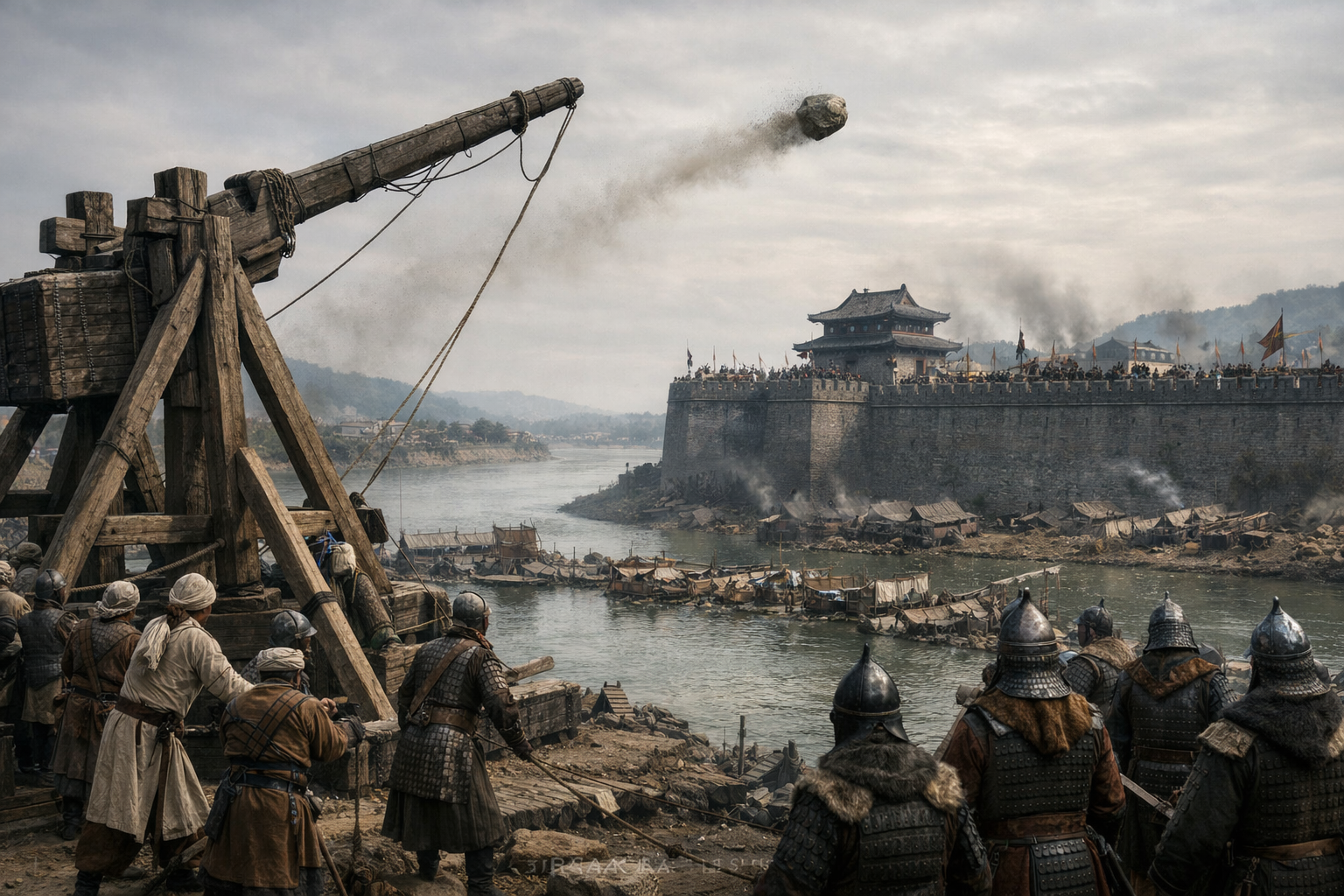
The Lock on the Han River
By the mid-1260s, Kublai Khan had already accomplished what no conqueror before him had managed. He had seized northern China, subdued Korea, and established his capital at Dadu, the city that would one day become Beijing. But southern China, home to the wealthiest and most densely populated civilization on earth, remained beyond his grasp. The Southern Song Dynasty, battered and diminished, still commanded the loyalty of tens of millions and the revenues of a maritime trading empire that stretched to Southeast Asia.
To break the Song, Kublai's commanders understood they had to break one specific place first: Xiangyang.
Situated on the northern bank of the Han River in modern Hubei Province, Xiangyang and its sister city Fancheng on the southern bank formed a fortified pair controlling the only viable corridor into the Yangtze River basin. The Han River was the arterial highway of southern China. Whoever held Xiangyang held the key. The Song court had understood this for generations, and the fortifications showed it. Massive walls, deep moats fed directly by the Han, and a garrison of disciplined soldiers made the twin cities among the most formidable defensive positions in the medieval world.
In 1267, Kublai Khan dispatched his general Aju (son of the celebrated Uriyang-khadai) along with the Chinese defector and strategist Liu Zheng to begin operations. What followed was not a battle. It was something closer to a slow strangulation.
The Architecture of Blockade
Aju and Liu Zheng recognized immediately that direct assault was suicidal. They constructed an encircling network of fortified camps and watchtowers, with chain booms stretched across the Han River to prevent resupply by water. By 1268, the Mongol investment was essentially complete. Xiangyang and Fancheng were not yet starving, since their granaries were deep and the garrison resourceful, but they were cut off from the Song heartland.
The Song response was energetic and, for a time, effective. A relief fleet commanded by Admiral Zhang Shun and Zhang Gui fought its way up the Han in 1272, reportedly carrying five thousand dan of grain and supplies into Fancheng under heavy fire. Contemporary Chinese sources describe the battle as ferocious: Zhang Shun was killed by arrows during the approach, and Zhang Gui was wounded, but the supplies reached the city. It was a feat of desperate heroism. And it was insufficient. The Mongol blockade tightened again within weeks.
For the soldiers and civilians inside Xiangyang, the years ground on with a particular psychological cruelty. They could see the Mongol camps on the hills. Their commander, Lu Wenhuan, kept order and morale through a combination of personal charisma and iron discipline. Song historians would later describe him as one of the great defenders of the dynasty, a man who held an impossible position through sheer will for five years.
Will alone cannot hold walls forever.
Engineers from the West
By 1272, Kublai Khan was growing impatient. His advisors had informed him that conventional siege methods, including scaling ladders, battering rams, and even the sophisticated Chinese traction trebuchets his engineers deployed, were inadequate against Xiangyang's water-reinforced defenses. The moats were too wide. The walls were too high. The city needed to be broken from a distance, with a force no existing machine in his arsenal could deliver.
The solution came from the opposite end of the Mongol world.
Kublai sent a request westward to his brother Hulagu's successor in Persia, the Ilkhanate. The Ilkhanid court dispatched two engineers, named in Chinese sources as Ismail and Ala al-Din, who were masters of the manjaniq, the counterweight trebuchet that Islamic and Crusader engineers had refined over generations of warfare in the Middle East and Central Asia. These were not the traction trebuchets that Chinese armies had used for centuries, powered by teams of men pulling ropes. The counterweight trebuchet used a massive weighted arm to store and release gravitational energy, hurling projectiles of up to 150 kilograms with far greater consistency and destructive power.
The two engineers arrived at Xiangyang in 1273. According to the Yuan Shi, the official dynastic history compiled after the Mongol conquest, when the first machine was assembled and fired against Fancheng's walls, the impact caused panic within the city. Whether or not the account is embellished, the strategic effect was real and immediate: Fancheng fell within days of the trebuchets being deployed.
With Fancheng gone, Xiangyang's position became untenable. Lu Wenhuan, recognizing that continued resistance meant the annihilation of his garrison and the civilian population, negotiated a surrender. He was treated with notable respect by the Mongols, a deliberate political signal. Kublai Khan wanted the remaining Song commanders to understand that honorable surrender was possible. The gate to southern China swung open.
Why Xiangyang Mattered Beyond Its Walls
The fall of Xiangyang in early 1273 was not merely a military event. It was a psychological rupture. The Song court at Lin'an (modern Hangzhou) had believed, with some justification, that the twin fortresses could hold indefinitely. The Han River line had been the dynasty's insurance policy. When that policy expired, the political consequences were immediate: factionalism at court intensified, confidence in the dynasty's survival collapsed, and the Song's capacity to organize coherent resistance began to unravel.
Kublai's commander Bayan, one of the most capable generals in Mongol history, was given command of the main invasion force in 1274. He moved with deliberate speed, following the Han River south toward the Yangtze, accepting surrenders where he could and overwhelming resistance where he had to. The campaign was notable for its relative restraint compared to earlier Mongol conquests. Kublai had explicitly instructed his commanders to minimize destruction of the agricultural and commercial infrastructure he intended to inherit and tax.
Historians debate how consistently that restraint held. Timothy Brook and other scholars of the Yuan period have noted that while large-scale massacres were avoided in many southern cities, violence against resisting populations did occur. The disruption of the Song administrative and economic system was severe regardless of intent. The conquest was not gentle. It was simply less apocalyptic than what the Jurchen Jin or the Khwarazmian Empire had experienced.
The Last Years of the Song
The Song did not die quietly. After the fall of Lin'an in 1276, when the child emperor Gongdi was captured along with the empress dowager, loyalist officials fled south with two younger princes. For three more years, a rump Song court operated from ships and coastal redoubts, supported by the admiral Zhang Shijie and the minister Lu Xiufu.
The final act came at the naval battle of Yamen in March 1279, fought in the waters off modern Guangdong Province. The loyalist fleet, carrying the last Song emperor, a child of seven named Zhao Bing, was cornered and destroyed by Mongol naval forces under the commander Zhang Hongfan. Lu Xiufu, refusing to allow the emperor to fall into Mongol hands, reportedly jumped into the sea holding the child. Zhao Bing drowned. The Song Dynasty, which had governed China in one form or another since 960 CE, ceased to exist.
The Yuan Dynasty had been formally proclaimed by Kublai Khan in 1271, before the conquest was even complete, a deliberate act of ideological positioning. It was now the uncontested ruler of all China.
The Weight of What Was Won
The siege of Xiangyang is sometimes overshadowed in popular history by more dramatic episodes: the sack of Baghdad in 1258, the invasion of Japan, the battles of Mohi and Legnica in Europe. In terms of strategic consequence, though, few events in the Mongol imperial story match it. Southern China was the most economically productive region on earth in the thirteenth century. Its rice agriculture, silk industry, and maritime trade networks generated revenues that dwarfed anything available in the steppe or Central Asia.
By taking it, Kublai Khan transformed the nature of the Mongol enterprise. He was no longer merely a conqueror. He was the emperor of the most populous and productive state in the world, ruling from a Chinese-style capital, employing Chinese-style bureaucrats, and working through Chinese-style court politics. The tension between that identity and his Mongol heritage would define, and destabilize, the Yuan Dynasty for the next century.
But in the spring of 1273, standing before the opened gateway of the Han River, all of that lay in the future. What mattered was that the lock had broken, and the door to China stood wide.
Editor's Context
Read this episode through mobility and information. Mongol power rested not only on battlefield speed, but on logistics, intelligence, delegated rule, and the ability to turn conquest into communication across Eurasia. The date markers (1267 CE — Mongol siege of Xiangyang begins, 1271 CE — Song relief fleet under Zhang Shun breaks through) are included because chronology is one of the easiest places for narrative history to become misleading. The episode's themes (Siege warfare and military technology transfer, The transformation of Mongol identity through Chinese conquest, Strategic geography and the control of river corridors) are the editorial lens for weighing cause and consequence rather than treating the story as isolated trivia.
Reviewed under the EmpiresDiary editorial workflow by Obadiah.
Sources & Further Reading
Episode source notes
Claim: The twin cities of Xiangyang and Fandeng controlled the primary corridor into the Yangtze River basin via the Han River
Source: Morris Rossabi, Khubilai Khan: His Life and Times (University of California Press, 1988) (secondary)
Claim: Kublai sent a request to the Ilkhanate for counterweight trebuchet engineers, and two men named Ismail and Ala al-Din were dispatched
Source: Yuan Shi (Official History of the Yuan Dynasty), compiled 1370 CE, Biography of Ismail (primary)
Claim: The sound of the counterweight trebuchet's impact shook heaven and earth and caused panic within Fandeng
Source: Yuan Shi, juan 203, account of the siege of Xiangyang (primary)
Claim: Zhang Shun was killed by arrows during the relief operation of 1271 that brought supplies into Fandeng
Source: Song Shi (Official History of the Song Dynasty), Biography of Zhang Shun and Zhang Gui (primary)
Claim: Lu Xiufu jumped into the sea holding the child emperor Zhao Bing at the Battle of Yamen in 1279
Source: Song Shi, juan 451, Biography of Lu Xiufu (primary)
Claim: Kublai formally proclaimed the Yuan Dynasty in 1271 before the conquest of southern China was complete
Source: Morris Rossabi, Khubilai Khan: His Life and Times (University of California Press, 1988), pp. 78–80 (secondary)
Claim: The conquest caused severe disruption to the Song administrative and economic system despite relative restraint in large-scale massacres
Source: Timothy Brook, The Troubled Empire: China in the Yuan and Ming Dynasties (Harvard University Press, 2010) (scholarly)
Claim: Counterweight trebuchets could hurl projectiles of significantly greater mass and consistency than traction trebuchets
Source: Paul E. Chevedden, 'The Hybrid Trebuchet: The Halfway Step to the Counterweight Trebuchet,' in On the Social Origins of Medieval Institutions (Brill, 1998) (scholarly)
Full bibliography for this series: The Mongol Empire: From Steppes to Superstates.
Drafted with AI. Accuracy review and corrections are ongoing — if you spot an error, please report it. See our workflow and editorial policy.