The Battle of Ain Jalut: When the Mongols Bled
The World Before the Battle
By the summer of 1260, the Mongol Empire had already done the unthinkable several times over. Baghdad had fallen in February 1258. The Abbasid Caliph al-Musta'sim had been executed, reportedly wrapped in felt and trampled by horses to avoid the spilling of royal blood, though some sources dispute the precise method. The city that had been the intellectual capital of the Islamic world for five centuries was burned, its libraries emptied into the Tigris, its population massacred in numbers that medieval chroniclers recorded in the hundreds of thousands, though modern historians treat those figures with caution.
The Mongol commander responsible was Hülegü Khan, a grandson of Genghis Khan and brother of the Great Khan Möngke. His Ilkhanate army then swept into Syria. Aleppo fell in January 1260 after a week of siege. Damascus surrendered without a major battle in March. Christian sources, including those from the Crusader states, recorded that Hülegü's Nestorian Christian wife Dokuz Khatun interceded for Damascus's Christian population, a detail that fed later legends of a Mongol-Christian alliance against Islam, though the political reality was considerably more transactional.
The Mongols now stood at the edge of Palestine. The Mediterranean was visible from their forward positions. Egypt, the last major Islamic power in the region, lay ahead.
The Death That Changed Everything
Then Möngke Khan died.
The Great Khan had been conducting a campaign against the Southern Song dynasty in China when he died in August 1259, most likely of dysentery contracted during the siege of Diaoyu Fortress in Sichuan, though some sources suggest cholera. His death triggered an immediate succession crisis. Hülegü, who needed to secure his position and his share of the imperial inheritance, withdrew the bulk of his forces eastward, leaving a significantly reduced garrison army in Syria under his general Kitbuqa.
The precise size of Kitbuqa's remaining force is debated. Reuven Amitai-Preiss, whose 1995 study Mongols and Mamluks remains the most rigorous scholarly treatment of this period, estimates the Mongol detachment at somewhere between ten thousand and twenty thousand men, formidable, but far below the full strength of the Ilkhanate army. This distinction matters enormously for how we interpret what followed.
The Mamluks: Slaves Who Became Kings
The force that would meet Kitbuqa had its own extraordinary origin story. The Mamluks were military slaves, predominantly of Kipchak Turkic and later Circassian origin, purchased as boys, raised in military barracks in Cairo, trained to an exceptional standard of horsemanship and archery, and converted to Islam. They had been the elite fighting force of the Ayyubid sultans of Egypt. In 1250, they had turned on their masters, assassinating the last Ayyubid sultan of Egypt and seizing power for themselves.
The sultan who led them to Ain Jalut was Qutuz, whose own origins were murky, he claimed Khwarazmian royal descent, though historians treat this with skepticism, suspecting it was a legitimizing fiction. He had come to power in 1259 by deposing his predecessor, partly on the argument that Egypt needed a warrior king to face the Mongol threat. His second-in-command was Baybars al-Bunduqdari, a brilliant and ruthless general who had his own ambitions and would eventually murder Qutuz on the road back from victory.
When Mongol envoys arrived in Cairo demanding Egypt's submission, Qutuz had them executed, a calculated act of defiance that made retreat politically impossible and committed Egypt to war.
The Crusaders Step Aside
The Crusader states of the Levantine coast faced an extraordinary choice. Both the Mongols and the Mamluks had at various points been their enemies. Now the Mamluks asked for safe passage through Crusader-controlled territory and permission to resupply at Acre.
The Crusader leadership, after debate, agreed to neutrality and permitted the Mamluk army to march north through their territory and to purchase supplies at Acre. This decision, strategic, pragmatic, and deeply consequential, has been analyzed by historians including David Nicolle and Joshua Prawer as reflecting a cold-eyed calculation: a Mamluk victory would leave a weakened Islamic power to the north; a Mongol victory would place an aggressive empire on their doorstep with no buffer remaining.
The Mamluk army moved north from Egypt in late August 1260. Kitbuqa, rather than waiting for a more defensible position, advanced to meet them.
The Spring of Goliath: 3 September 1260
The Jezreel Valley in northern Palestine, the same broad agricultural plain where, according to Hebrew scripture, the young David had confronted Goliath, gave the battle its name. Ain Jalut, the Spring of Goliath, lay near the modern Israeli town of Ein Harod.
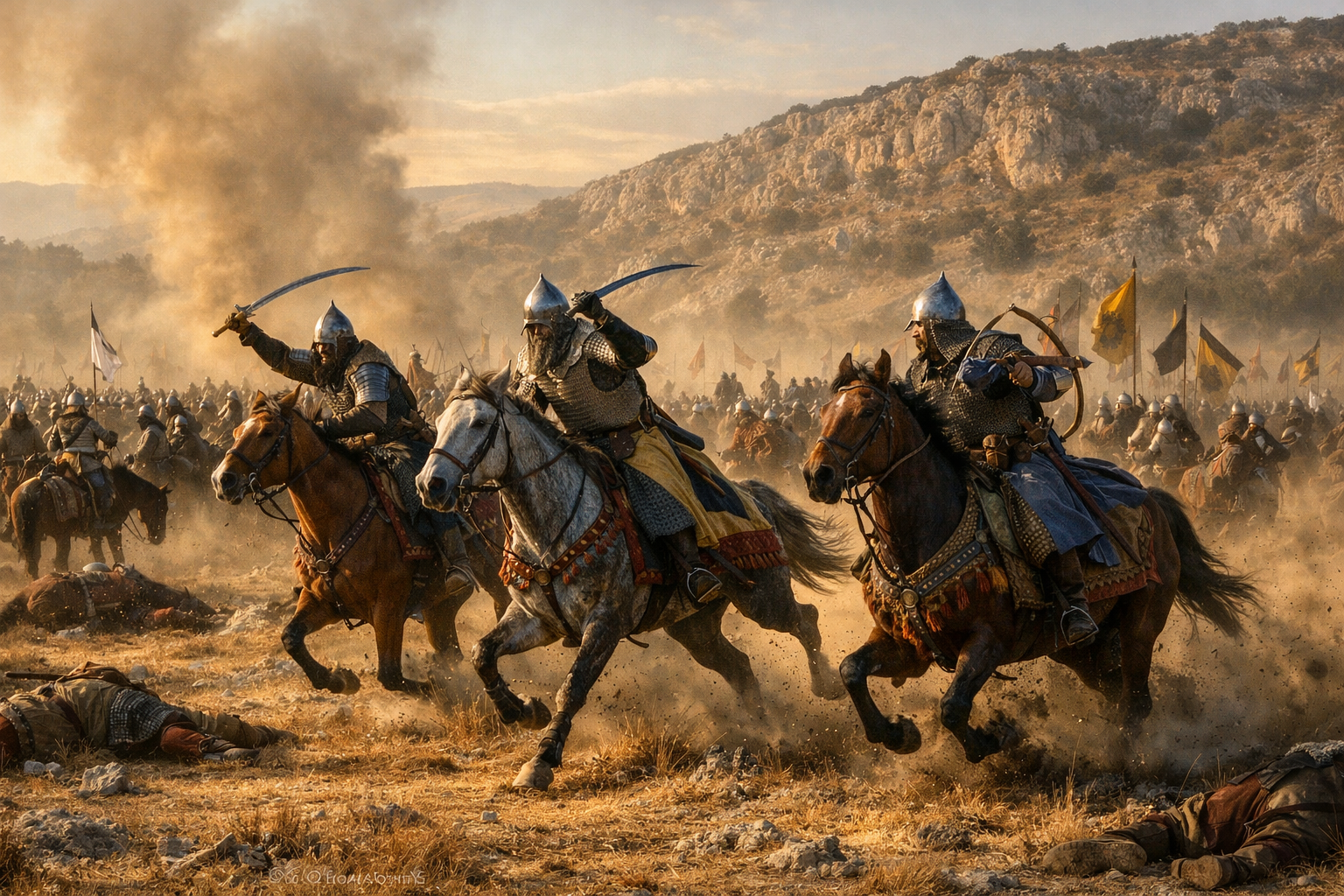
The tactical details of the battle are reconstructed primarily from Arabic sources, including Ibn 'Abd al-Zahir's biography of Baybars and later chronicles. The Mamluk army reportedly used a feigned retreat, a tactic the Mongols themselves had employed with devastating effect across decades of conquest. Baybars commanded the Mamluk vanguard, drew Kitbuqa's forces into pursuit, then wheeled as the main Mamluk army closed from the flanks and from concealed positions in the surrounding hills.
Kitbuqa was captured during or after the fighting and executed. His reported final words, as recorded in Arabic sources, were defiant, he is said to have declared that his death would bring Mongol vengeance, but these accounts were written by his enemies and should be treated as literary rather than documentary.
The Mongol force was not merely defeated; it was destroyed as a coherent military unit. Survivors were pursued and killed or scattered. Syria, which had submitted to the Mongols only months before, flipped almost immediately to Mamluk control. Damascus fell back into Islamic hands within weeks.
Why the Mongols Lost: Competing Explanations
Historians have offered several interlocking explanations for the Mongol defeat, and most serious scholarship treats them as cumulative rather than singular.
The most straightforward is numerical and political: Kitbuqa was operating with a fraction of Hülegü's full force because of Möngke's death and the succession crisis. He was, in a meaningful sense, fighting a battle the Mongol Empire had not fully committed to fighting.
A second explanation involves the limits of Mongol logistics in arid, densely populated terrain. The Mongol war machine was optimized for steppe and open grassland, where horses could graze freely and armies could maneuver at speed. The Fertile Crescent and Levant offered far less pasture per square mile than Central Asia or northern China. Some historians, including Timothy May in The Mongol Conquests in World History, have argued that the carrying capacity of Middle Eastern pastureland placed a hard ceiling on how large a Mongol army could sustainably operate west of the Zagros Mountains.
A third factor was the quality of the Mamluk army itself. These were not conscript levies or frightened city militias. They were professional cavalry soldiers trained in the same horse-archery tradition as the Mongols, familiar with Mongol tactics from direct experience, many Mamluks were themselves of Kipchak origin, from the same steppe culture that had produced Mongol cavalry techniques. They were, in a real sense, fighting the Mongols with the Mongols' own methods.
The Myth and the Reality
The historiography of Ain Jalut has its own drama. For much of the twentieth century, the battle was framed in sweeping civilizational terms: the moment Islam was saved, the moment Europe was spared, the hinge on which world history turned. J.J. Saunders in his 1971 The History of the Mongol Conquests gave the battle enormous weight.
Later scholarship pushed back. Amitai-Preiss argued persuasively that the Mongols made several subsequent serious attempts to retake Syria, all of which the Mamluks repelled, suggesting Ain Jalut was the beginning of a sustained military contest rather than a single decisive moment. The Ilkhanate launched major invasions of Syria in 1281, 1299, and 1303, winning at Homs in 1299 before being expelled again. The frontier between Mamluk Egypt and the Ilkhanate remained violently contested for decades.
What Ain Jalut did accomplish, with certainty, was to establish that the Mongols could be defeated in open field battle by a prepared Islamic army. That psychological and political fact reverberated across the Islamic world. The narrative of Mongol invincibility, carefully cultivated through decades of psychological warfare and deliberate terror, had a crack in it that could never fully be repaired.
Baybars and the Aftermath
On the road back from victory, Qutuz was assassinated. The sources agree that Baybars was involved; some suggest he struck the first blow himself. He then rode to Cairo and declared himself sultan.
Baybars al-Bunduqdari would rule Egypt and Syria until 1277, and his reign represented the consolidation of everything Ain Jalut had made possible. He rebuilt the Abbasid Caliphate in Cairo, installing a surviving member of the Abbasid family as a ceremonial caliph to provide religious legitimacy for Mamluk rule. He conducted successful campaigns against the Crusader states, taking Caesarea and Arsuf in 1265. He maintained an extraordinary diplomatic network, corresponding with the Golden Horde Mongols in the north, who were rivals of the Ilkhanate, and with the Byzantine Empire.
The Mamluk Sultanate he consolidated would endure until the Ottoman conquest of 1517. Its survival was, in a direct line of causation, traceable to a September afternoon in the Jezreel Valley.
The Fracture Lines of Empire
Ain Jalut did not happen in isolation. It happened because the Mongol Empire was already fracturing along lines of succession, geography, and religious difference. Hülegü's withdrawal was not cowardice; it was political necessity. The empire Genghis Khan had built was too vast, too diverse, and too dependent on personal authority to survive the death of a Great Khan without crisis.
The civil war between Kublai Khan and his brother Ariq Böke, which erupted openly in 1260, would eventually produce the formal division of the empire into four successor khanates: the Yuan dynasty in China, the Ilkhanate in Persia and Iraq, the Chagatai Khanate in Central Asia, and the Golden Horde in the Pontic steppe. These entities would fight each other as readily as they fought external enemies.
The Mongol Empire had not been stopped at Ain Jalut by a superior civilization or a providential force. It had been stopped by the accumulated weight of its own contradictions, and by a slave army that had learned to fight like Mongols and had no intention of dying like everyone else.
Editor's Context
Ain Jalut is one of history's most contested 'what if' moments. Some historians, following J.J. Saunders, elevated it into a civilization-saving clash; others, like Reuven Amitai-Preiss, offer a more measured reading—the Mongol force at Ain Jalut was a detachment, not a full imperial army, and the empire's westward ambitions were already constrained by pasture scarcity and political fragmentation after Möngke Khan's death. What makes the battle genuinely significant is not a single afternoon's fighting but the systemic lesson it delivered: the Mongol war machine was not a force of nature but a political and logistical organism, and organisms could be killed.
Reviewed under the EmpiresDiary editorial workflow by Obadiah.
Sources & Further Reading
Episode source notes
Claim: Möngke Khan died in August 1259, most likely of dysentery during the siege of Diaoyu Fortress in Sichuan
Source: Timothy May, The Mongol Conquests in World History (Reaktion Books, 2012) (secondary)
Claim: Reuven Amitai-Preiss estimates the Mongol force at Ain Jalut at between ten thousand and twenty thousand men
Source: Reuven Amitai-Preiss, Mongols and Mamluks: The Mamluk-Ilkhanid War, 1260–1281 (Cambridge University Press, 1995) (scholarly)
Claim: The Ilkhanate launched major invasions of Syria in 1281, 1299, and 1303
Source: Reuven Amitai-Preiss, Mongols and Mamluks: The Mamluk-Ilkhanid War, 1260–1281 (Cambridge University Press, 1995) (scholarly)
Claim: Baybars took Caesarea and Arsuf in 1265 and installed a ceremonial Abbasid caliph in Cairo
Source: Peter Thorau, The Lion of Egypt: Sultan Baybars I and the Near East in the Thirteenth Century, trans. P.M. Holt (Longman, 1992) (secondary)
Claim: Kitbuqa's reported final words are preserved in Arabic sources written by his enemies
Source: Ibn 'Abd al-Zahir, Sirat al-Malik al-Zahir (biography of Baybars), cited in Amitai-Preiss, Mongols and Mamluks (primary)
Claim: The Abbasid Caliph al-Musta'sim was executed reportedly by being wrapped in felt and trampled
Source: Various medieval sources; discussed critically in John Man, Genghis Khan: Life, Death and Resurrection (Bantam Press, 2004) (secondary)
Claim: J.J. Saunders gave Ain Jalut enormous civilizational weight in his 1971 study
Source: J.J. Saunders, The History of the Mongol Conquests (Routledge, 1971) (secondary)
Claim: Mongol war machine was optimized for steppe and that Middle Eastern pastureland placed a ceiling on sustainable army size west of the Zagros
Source: Timothy May, The Mongol Conquests in World History (Reaktion Books, 2012) (scholarly)
Full bibliography for this series: The Mongol Empire: From Steppes to Superstates.
Drafted with AI. Accuracy review and corrections are ongoing — if you spot an error, please report it. See our workflow and editorial policy.