The Plague Road: How the Black Death Traveled the Mongol Highway
The Roads That Connected Everything
By the mid-fourteenth century, the Mongol Empire had fractured into four successor states, the Yuan dynasty in China, the Ilkhanate in Persia, the Chagatai Khanate in Central Asia, and the Golden Horde on the Pontic steppe, but the infrastructure of empire endured. The yam relay system, a network of postal stations spaced roughly a day's ride apart, still threaded across thousands of miles of steppe, mountain, and desert. Merchants, diplomats, and soldiers moved along these corridors with a regularity that earlier centuries could not have imagined.
The Venetian and Genoese trading colonies planted along the Black Sea coast, at Tana on the Don estuary, at Soldaia, and most importantly at Caffa on the Crimean peninsula, were the western termini of this vast commercial web. Caffa, founded by Genoa in 1266 under a treaty with the Golden Horde, had grown into one of the most prosperous entrepôts in the medieval world. Silks from China, spices from the Indian Ocean, furs from the northern forests, and slaves from the steppe all passed through its warehouses. The city was, in the words of the chronicler Gabriele de' Mussis (writing in the late 1340s), a place where 'merchants from everywhere gathered.'
What none of these merchants, Mongol administrators, or Genoese traders understood was that somewhere along those same roads, in the grasslands and rodent colonies of Central Asia, a bacterium was moving.
Origins in the Steppe: The Biological Reservoir
The question of where the Black Death originated has generated sustained scholarly debate. For much of the twentieth century, historians pointed vaguely to 'Central Asia' or 'China,' but recent work, particularly the 2022 ancient DNA study led by Maria Spyrou and Johannes Krause published in Nature, has provided extraordinary precision. Analysis of skeletal remains from cemeteries near Issyk-Kul in what is now Kyrgyzstan, dated to 1338, 1339, revealed the presence of Yersinia pestis genetically ancestral to the strains that would devastate Europe and the Middle East. Tombstone inscriptions from those cemeteries, written in Syriac by a Christian community, record deaths in unusual numbers and in some cases explicitly note 'pestilence' as the cause.
Issyk-Kul sat within the Chagatai Khanate, along a well-traveled branch of the Silk Road. The region was home to vast populations of burrowing rodents, marmots, ground squirrels, gerbils, which form the long-term reservoir for Yersinia pestis in Central Asia. Ecological disruption, whether from climate fluctuation, drought, or the movement of large armies and herds, can push infected rodents into contact with human settlements and the fleas that bridge animal and human hosts. The precise trigger in the late 1330s remains uncertain, but the genetic evidence now anchors the pandemic's origin to the Tian Shan region with a confidence that was impossible before ancient DNA analysis.
From Issyk-Kul, the disease had a highway waiting for it.
Westward Along the Golden Horde
The Chagatai Khanate and the Golden Horde shared porous borders and regular commercial contact. By the early 1340s, plague appears to have been moving through the steppe populations of the Golden Horde's territory. Contemporary sources are fragmentary and often retrospective, but later Arabic chronicles and European accounts converge on a picture of devastating mortality spreading through the Pontic steppe and the Caucasus region around 1345, 1346.
The Golden Horde's khan at this time was Jani Beg, who had come to power in 1342 after a violent succession struggle. Jani Beg was an ambitious ruler who sought to control the lucrative Black Sea trade, and his relationship with the Genoese colony at Caffa was contentious. In 1343, a violent incident, the killing of a Mongol official by Italian merchants, or possibly a broader brawl with ethnic and commercial dimensions, had prompted Jani Beg to lay siege to Caffa. The siege was lifted, resumed, and by 1346 had become a prolonged military operation.
And then the plague arrived in the besieging army.
The Siege of Caffa and the Weapon No One Understood
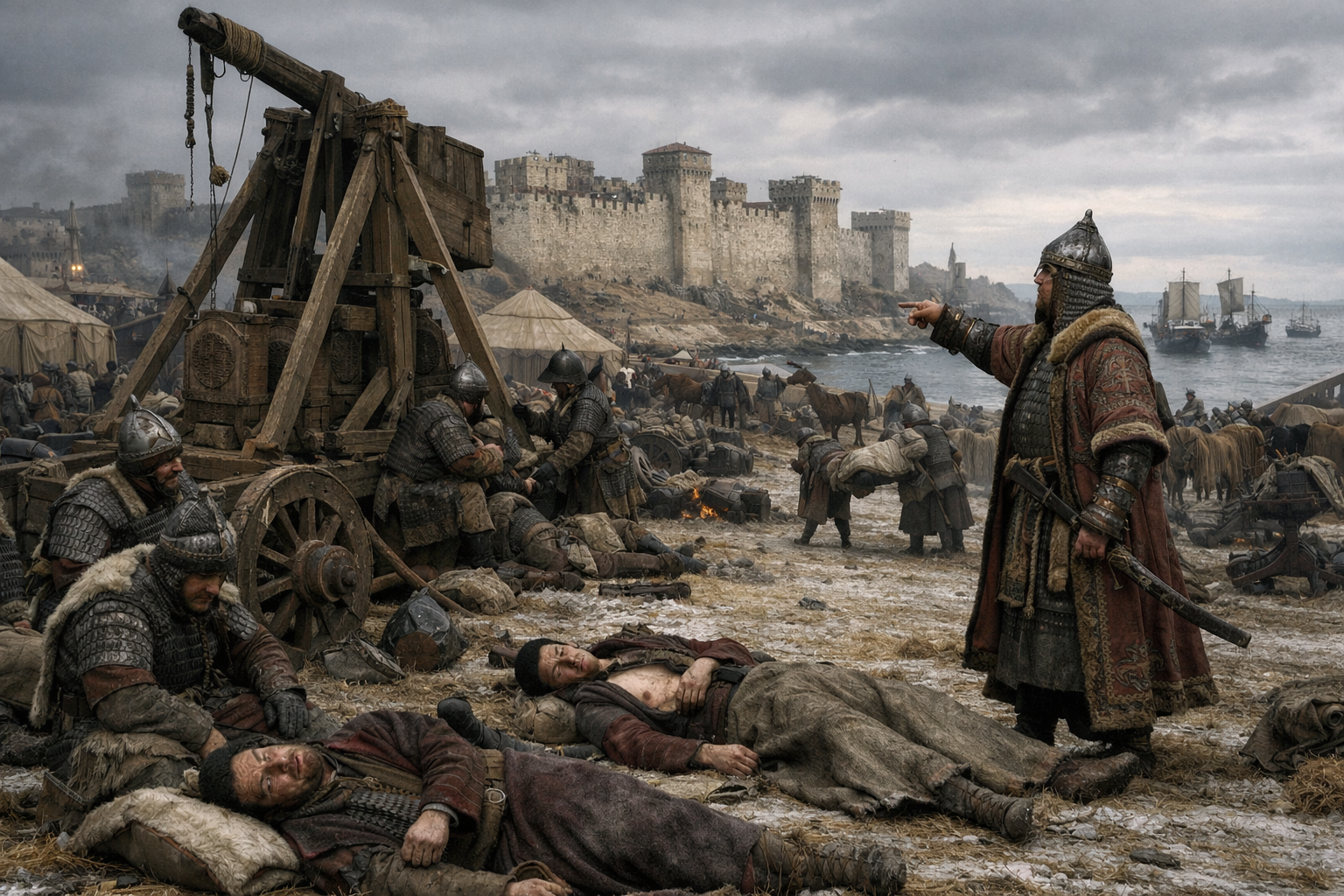
Gabriele de' Mussis, a notary from Piacenza who claimed either direct or indirect knowledge of events at Caffa, provides the most vivid account of what happened next. Writing sometime after 1348, he described how the Mongol forces, struck by a mysterious and lethal disease, began catapulting the corpses of their dead over the walls of Caffa into the city below. The intent, as de' Mussis framed it, was to use the rotting bodies as a form of biological weapon, to spread the corruption of death among the defenders.
Historians have debated how much weight to give this account. De' Mussis was not an eyewitness to the siege itself, and his narrative has a dramatic, almost providential quality that reflects medieval Christian frameworks for understanding catastrophe. Yet the basic mechanism he describes, corpse-throwing as psychological and potentially biological warfare, was not unknown in medieval siege practice, and the account is not inherently implausible. What is far less certain is whether this act of catapultage was the primary vector by which plague entered Caffa, or whether the bacterium had already infiltrated the city through rats and fleas moving through the siege lines independently of any deliberate action.
What is not in dispute is that by 1346, 1347, plague was inside Caffa, and the Genoese were dying.
Flight from Caffa: The Ships That Carried Death West
As conditions in Caffa became untenable, Genoese and other Italian merchants loaded their ships and fled westward. This was the critical moment of transmission. The ships that departed Caffa in 1347 carried not only their human crews and cargo but also the rats and fleas in their holds, and with them, Yersinia pestis.
The ships called at Constantinople, already a city under demographic and political pressure. The Byzantine Empire, exhausted by civil war and territorial contraction, had no capacity to quarantine or contain what was arriving in its harbors. From Constantinople, the plague spread rapidly through the sea lanes of the eastern Mediterranean. By the autumn of 1347, infected ships had reached Messina in Sicily, and according to the Franciscan friar Michele da Piazza, the sailors who arrived there 'bore sickness in their very bones.' The authorities of Messina ordered the ships out of harbor, but it was already too late.
Within months, the plague was in mainland Italy, in Marseille, in the ports of North Africa. By 1348 it was moving through France and the Iberian Peninsula. By 1349 it had crossed the Alps and was devastating the cities of the Holy Roman Empire. By 1350 it had reached Scandinavia and the British Isles. The mortality rates recorded in contemporary chronicles and confirmed by modern demographic analysis were staggering, between one-third and one-half of Europe's population dead within five years, with some regions losing far more.
The Mongol World Also Burned
It would be a profound distortion to tell this story only from the European endpoint. The plague ravaged the Mongol successor states with comparable ferocity. The Golden Horde, already weakened by internal succession conflicts, suffered catastrophic population losses on the steppe and in its urban centers. The Ilkhanate in Persia, which had already collapsed as a functioning political entity by 1335, saw its former territories devastated. Egypt and Syria under the Mamluk Sultanate, which had defeated the Mongols at Ain Jalut in 1260 and remained outside Mongol control, were nonetheless connected to the same trade networks and suffered mortality on a scale that contemporaries struggled to comprehend. The Egyptian scholar Ibn al-Wardi, who died of plague in Aleppo in 1349, wrote a firsthand account describing the disease moving from 'the land of the darkness', the northern steppe, through the Islamic world.
In China, the Yuan dynasty faced its own catastrophic mortality in the 1330s and 1340s, though the relationship between Chinese epidemic events and the Yersinia pestis strains identified at Issyk-Kul remains a subject of active scholarly investigation. What is clear is that the pandemic was not a disease that struck Europe from outside, it was a disease that struck the entire connected world of the Mongol era, and Europe was simply the last major region to receive it.
The Infrastructure of Catastrophe
The deepest historical irony of the Black Death is that it could not have traveled so far so fast without the Mongol achievement. The yam system, the suppression of banditry along trade routes, the Mongol policy of protecting merchants and encouraging long-distance commerce, all of these had created a Eurasian world more tightly integrated than anything that had existed before. The Franciscan friar William of Rubruck could travel from France to the Mongol court in the 1250s. The Moroccan scholar Ibn Battuta could traverse the entire breadth of the Mongol world in the 1330s. Goods, ideas, technologies, and peoples moved with unprecedented freedom.
And so did pathogens.
The Pax Mongolica, the relative peace and commercial openness that the Mongol system enforced across Eurasia, was real, and its benefits for trade, cultural exchange, and technological diffusion were substantial. But it was a peace built on the infrastructure of conquest, maintained by violence, and it created a biological unity of the Eurasian landmass that human immune systems were wholly unprepared to navigate. The roads that carried porcelain and pepper from China to the Mediterranean also carried the flea on the rat in the hold of the ship that docked at Messina in October 1347.
The Mongol Empire would not survive the fourteenth century. The Yuan dynasty fell to the Ming in 1368. The Golden Horde fragmented. The Ilkhanate was already gone. But the plague they had, entirely inadvertently, helped to transmit across the world would reshape every civilization it touched, accelerating the end of feudal labor systems in Europe, destabilizing the Islamic world's demographic foundations, and leaving a psychological scar on human culture that persisted for centuries.
The steppes had given the world an empire. The empire had given the world a highway. And the highway had given the world its worst nightmare.
Editor's Context
The Black Death is almost always taught as a European catastrophe, but its origins and early trajectory are inseparable from Mongol geopolitics. The pandemic did not simply 'arrive' in the West — it was transmitted along a human-built infrastructure of conquest and commerce. Understanding this forces a reckoning with the double-edged legacy of the Pax Mongolica: the same imperial system that enabled the first truly Eurasian economy also created the conditions for the worst demographic disaster in recorded history. Historians like Monica Green and Robert Hymes have pushed the field toward a more globally integrated account of plague origins, and their work reframes the Black Death not as a European story but as a Mongol-era world event.
Reviewed under the EmpiresDiary editorial workflow by Obadiah.
Sources & Further Reading
Episode source notes
Claim: Ancient DNA from skeletal remains at Issyk-Kul cemeteries dated 1338–1339 revealed Yersinia pestis ancestral to Black Death strains
Source: Spyrou, M.A. et al. 'The source of the Black Death in fourteenth-century central Eurasia.' Nature 606 (2022): 718–724. (scholarly)
Claim: Caffa was founded by Genoa in 1266 under treaty with the Golden Horde
Source: Balard, Michel. La Romanie génoise (XIIe–début du XVe siècle). Rome: École Française de Rome, 1978. (scholarly)
Claim: Gabriele de' Mussis described Mongol forces catapulting plague corpses into Caffa
Source: Horrox, Rosemary, ed. and trans. The Black Death. Manchester: Manchester University Press, 1994. (Contains translation of de' Mussis's account.) (secondary)
Claim: Michele da Piazza described the arrival of plague-stricken sailors at Messina in autumn 1347
Source: Horrox, Rosemary, ed. The Black Death. Manchester: Manchester University Press, 1994. (secondary)
Claim: Ibn al-Wardi wrote a firsthand account of plague moving from the northern steppe through the Islamic world and died of plague in Aleppo in 1349
Source: Dols, Michael W. The Black Death in the Middle East. Princeton: Princeton University Press, 1977. (scholarly)
Claim: Mortality rates from the Black Death in Europe ranged between one-third and one-half of the population within five years
Source: Benedictow, Ole J. The Black Death 1346–1353: The Complete History. Woodbridge: Boydell Press, 2004. (scholarly)
Claim: The yam relay postal system connected Mongol-controlled territories across Eurasia with stations spaced roughly a day's ride apart
Source: Morgan, David. The Mongols. 2nd ed. Oxford: Blackwell, 2007. (scholarly)
Claim: Jani Beg came to power in the Golden Horde in 1342 after a violent succession struggle
Source: Halperin, Charles J. Russia and the Golden Horde. Bloomington: Indiana University Press, 1985. (scholarly)
Full bibliography for this series: The Mongol Empire: From Steppes to Superstates.
Drafted with AI. Accuracy review and corrections are ongoing — if you spot an error, please report it. See our workflow and editorial policy.