The Young Turk Revolution
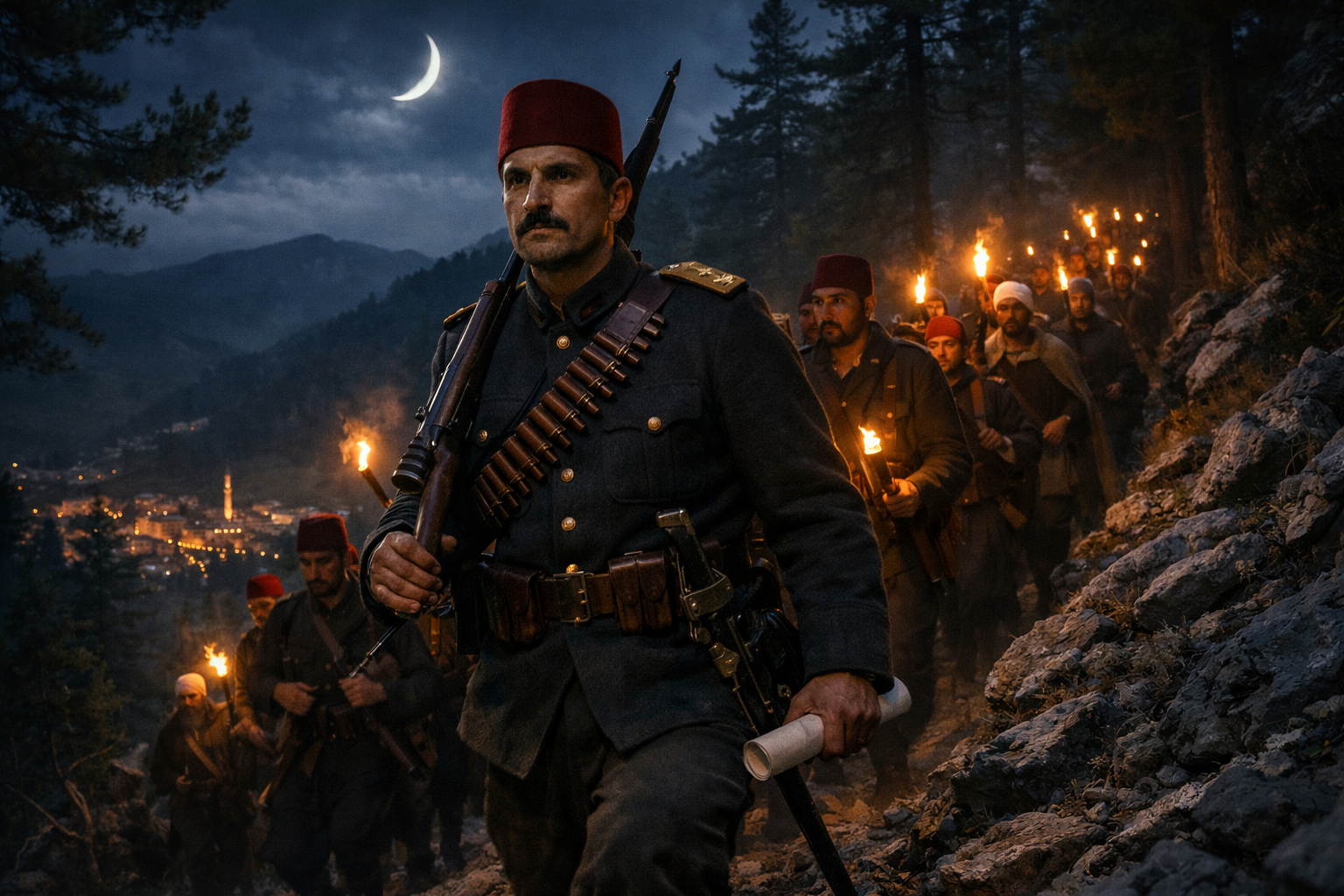
A Night of Defiance in Resne
July 3, 1908. The sun had barely set over the Ottoman town of Resne (modern-day Resen, North Macedonia) when Major Ahmed Niyazi Bey, an officer of the local garrison, made his fateful decision. With 200 soldiers and civilians behind him, he seized the military treasury and disappeared into the mountains of Macedonia. In his pocket was a manifesto demanding the restoration of the Ottoman Constitution of 1876, suspended by Sultan Abdul Hamid II three decades earlier.
The warm Balkan night buzzed with tension as telegraph operators worked frantically to spread word of the rebellion. In coffee houses across the empire, young officers and intellectuals who had long plotted in secret began to emerge from the shadows. They called themselves the Committee of Union and Progress (CUP), known to history as the Young Turks.
Sultan Abdul Hamid II received the news in Istanbul with growing alarm. His vast network of spies had kept the empire under suffocating surveillance for decades, yet it seemed powerless against this new threat. When he ordered loyal troops to crush the rebellion, entire units defected to join the constitutionalists instead.
Within days, other military commanders followed Niyazi's example. Major Enver Bey, who would later become one of the empire's most powerful leaders, led his own forces into the hills. Telegrams poured into the capital from across Macedonia and Thrace, all bearing the same demand: restore the constitution or face revolution.
The Sick Man's Struggles
The Ottoman Empire of 1908 was a shadow of its former glory. Once stretching from the gates of Vienna to the Persian Gulf, it had lost territory in nearly every war of the previous century. European powers dubbed it "the sick man of Europe" and circled like vultures, waiting for its collapse.
Abdul Hamid II had come to power in 1876 amid high hopes. He initially accepted a constitution that would have transformed the empire into a constitutional monarchy, but after just two years he suspended it along with parliament, instituting a highly centralized autocracy maintained through censorship and repression.
Even so, new ideas spread through the empire's educational institutions and military academies. Young officers and intellectuals, exposed to European concepts of nationalism and constitutionalism, formed secret societies. Many drew inspiration from the Young Ottoman movement of the 1860s-1870s, which had first called for constitutional reform. The CUP emerged as the most powerful of these groups, particularly strong among officers stationed in the Balkans. They believed the empire's weakness stemmed from autocratic government, and that only constitutional rule could prevent its collapse.
Main Narrative: Revolution and Response
The rebellion spread fast through Macedonia. In Monastir, Salonica, and other Balkan cities, military units declared their support for the constitution. The CUP's organization, built through years of secret recruitment, proved remarkably effective. Their network of telegraph operators gave them control over the flow of information, while sympathetic railway workers helped move supporters and supplies.
Salonica was the revolution's intellectual heart. Crowds filled the streets in celebration, and Muslims, Christians, and Jews embraced each other as fellow citizens, convinced a new era of freedom and equality had arrived. Committee members gave fiery speeches promising reform, modernization, and an end to foreign interference. The joy in the streets was genuine and widespread, a release of decades of pent-up frustration under autocratic rule.
The Sultan's response veered between conciliation and repression. He dispatched his trusted general, Semsi Pasha, to crush the rebellion in Macedonia. On July 7, as Semsi read a telegram in Monastir's post office, a young CUP officer named Atif Kamcil shot him dead in broad daylight. The message was plain: there would be no turning back.
Reports arriving at the palace described whole army corps declaring for the constitution. The spy network that had seemed omnipotent for so long crumbled as its agents either joined the revolution or fled. It was a swift, almost total collapse of the Sultan's intelligence apparatus.
On July 23, faced with the possibility of the rebel army marching on Istanbul, Abdul Hamid II capitulated. He declared the restoration of the 1876 constitution and ordered new elections for parliament. The empire erupted in celebration.
Consequences: Hope and Disillusionment
The immediate aftermath seemed to fulfill the revolution's promise. Elections were held, a parliament convened, and press censorship ended. Hundreds of new newspapers and political parties emerged almost overnight. The empire's various ethnic and religious communities looked forward to a future of equality and cooperation.
The unity didn't last. The CUP, though officially supporting parliamentary democracy, increasingly acted as a shadow government. Internal divisions opened between moderates and radicals, while ethnic tensions rose as different groups pursued competing nationalist agendas. The celebration in Salonica's streets began to feel, in hindsight, like a brief and fragile moment.
The revolution's lasting impact was still profound. It marked the beginning of the empire's final phase and introduced modern mass politics to Ottoman society. The constitutional experiment would face severe challenges, including a counter-revolution in 1909, but the old absolutist system was gone for good.
The Young Turk Revolution would have consequences far beyond the Ottoman Empire's borders. In the next episode, we'll explore how the revolution inspired similar movements across the Muslim world, from Persia to Morocco. We'll also examine how the CUP's increasing authoritarianism and nationalism shaped the empire's fate in its final years, feeding into the crucial decisions made on the road to World War I.
Editor's Context
Read this episode as a study in imperial administration as much as conquest. Ottoman power depended on frontier politics, fiscal systems, elite bargains, and the ability to absorb local complexity. The date markers (1908, 200) are included because chronology is one of the easiest places for narrative history to become misleading. The episode's themes (history, empire, power) are the editorial lens for weighing cause and consequence rather than treating the story as isolated trivia.
Reviewed under the EmpiresDiary editorial workflow by Obadiah.
Drafted with AI. Accuracy review and corrections are ongoing — if you spot an error, please report it. See our workflow and editorial policy.